








An uninterruptible power supply — commonly written as UPS, and often called a UPS system, UPS power supply, or UPS unit — is a device that keeps a connected load running when the incoming utility power fails or drifts outside acceptable limits. It combines energy storage (almost always batteries), power conversion electronics, and monitoring in one package: the UPS senses voltage sags, outages, frequency excursions, and transients, and transfers the load to its stored energy so quickly that sensitive equipment never notices. This guide explains the three UPS topologies, how to size a UPS in kVA, how battery backup time is calculated, how a UPS compares with surge protectors, voltage regulators, and PDUs, and what it takes to integrate one cleanly with industrial control cabinets — a common request in our custom cabinet and distribution projects. Final ratings, code compliance, installation, and testing requirements must always be confirmed by qualified engineering for the specific project.
What an uninterruptible power supply does
The definition of an uninterruptible power supply comes down to continuity: the load sees regulated power at all times, whether the utility feed is healthy, sagging, or gone. Inside every UPS power supply three functional blocks cooperate. A rectifier or charger conditions incoming AC and maintains the battery bank. An inverter reconstructs clean AC from DC whenever the UPS is supporting the load. A static switch decides, in real time, whether the load is fed from the line, from the inverter, or — during maintenance — from an internal bypass path. Around these blocks, the UPS continuously monitors input voltage and frequency against a window; anything outside the window triggers a transfer to battery power before the connected equipment registers the disturbance.
The applications differ in scale but follow the same logic. In a server room, a UPS unit buys the minutes needed to shut systems down safely or wait for a generator. In a factory, a small UPS protecting a PLC control cabinet holds up the controller, HMI, and communications while actuators fail safe — fifteen minutes of control power is often the difference between a clean stop and a scrapped batch. In process industries, UPS-backed instrument buses keep measurement and safety loops alive through momentary dips that would otherwise trip an entire line.
The three UPS topologies
Not every UPS unit works the same way. IEC 62040-3 sorts the practical architectures into VFD (voltage and frequency dependent), VI (voltage independent), and continuous-operation classes; the market usually describes them as standby, line-interactive, and online double-conversion.
| Topology | How the load is normally fed | Behavior on utility failure | Typical use |
|---|---|---|---|
| Standby (offline, VFD) | Directly from utility through basic filtering | Transfers to inverter, typically within a few milliseconds (commonly quoted as 2–10 ms) | Office PCs, single workstations, non-critical loads |
| Line-interactive (VI) | From utility through a built-in automatic voltage regulator (AVR) | AVR corrects moderate sags and swells without using the battery; deeper events transfer to battery in milliseconds | IT racks, network closets, lighter industrial duty |
| Online double-conversion (VI/SSY continuous) | Always through the rectifier–inverter path; the battery floats on the DC link | No transfer at all — the DC bus simply carries the load; output voltage and frequency are fully regenerated | Industrial control systems, process automation, medical and data loads |
The trade-off is cost against power quality. A double-conversion UPS system rebuilds the output waveform from scratch, so it isolates the load from harmonics, frequency drift, and brownouts — at the price of continuous conversion losses (modern units typically run in the low-to-mid 90s percent efficiency) and a higher purchase cost. Standby and line-interactive designs are cheaper and cooler-running but pass many disturbances through and only act on the severe ones.
How to size a UPS in kVA
UPS capacity is stated in kVA (apparent power), while equipment nameplates usually state watts (real power). Sizing is a four-step exercise:
1. List every load the UPS will carry, with its nameplate watts or VA. For a control cabinet, that is typically the PLC power supply, HMI, network switches, and any instruments powered from the same bus.
2. Convert to VA using each device’s input power factor (older equipment around 0.6–0.8; modern switch-mode supplies with power factor correction, 0.95 and above).
3. Add the VA values, then apply a loading target of no more than about 80% of UPS rating — headroom for inrush, future additions, and battery-charging behavior after an outage.
4. Choose the next standard UPS rating above the result.
A worked example: a control system drawing 5,000 W at 0.9 power factor needs about 5,560 VA; dividing by a 0.8 loading target gives roughly 6,950 VA, so a 7.5–8 kVA unit is the sensible pick. Online UPS sizing calculators (sometimes searched as an “uninterrupted power supply calculator”) do this arithmetic instantly, but the inputs — the load list and power factors — still have to come from your equipment. When batteries are part of the same exercise, battery sizing calculators apply the same logic to ampere-hours.
Calculating UPS battery backup time
UPS battery runtime follows a simple energy balance: the battery bank stores ampere-hours at a DC voltage, and the inverter delivers them to the load at an efficiency that is typically 90% or better. A first-order estimate is:
Runtime (hours) ≈ battery Ah × battery bank voltage × inverter efficiency ÷ load in watts
For example, a 40 Ah string at 96 V DC (eight 12 V blocks in series) supporting a 500 W load: 40 × 96 × 0.9 ÷ 500 ≈ 6.9 hours at that modest load. Real UPS battery backup runs shorter than the simple formula because high discharge rates reduce effective capacity, temperature matters, and batteries age — treat the result as an optimistic ceiling and verify against the manufacturer’s discharge curves.
Two battery chemistries dominate. VRLA (sealed lead-acid) batteries are inexpensive and well understood, but expect a service life of roughly 3–5 years in standby duty and provide lower energy density. Lithium-ion batteries (typically LiFePO4 chemistry in stationary UPS duty) cost more up front, last around ten years or more in favorable conditions, pack more energy into a smaller battery cabinet, and ship with a battery management system that monitors cell health. For industrial enclosures, the chemistry choice drives ventilation and thermal decisions discussed below.
UPS vs surge protector vs voltage regulator vs PDU
These four devices are frequently confused because they all sit between the utility and the load, but they solve different problems. A surge protector (surge protective device, SPD) only clamps brief transient overvoltages — lightning-induced spikes and switching surges measured in microseconds — and does nothing for an outage. A voltage regulator or power conditioner corrects sustained low or high voltage, and a power conditioner typically adds noise filtering, but neither stores energy. A PDU distributes power to individual equipment within a rack or cabinet; basic models provide no protection at all, while intelligent models add metering and switching. Only the uninterruptible power supply carries the load through a complete interruption.
| Capability | UPS (double-conversion) | Surge protector / SPD | Voltage regulator / power conditioner | PDU |
|---|---|---|---|---|
| Stored energy (rides through an outage) | Yes — minutes of battery backup | No | No | No |
| Corrects sustained under/overvoltage | Yes, continuously | No | Yes (that is its whole job) | No |
| Clamps transient surges | Partially (internal suppression is secondary) | Yes — its core function, rated in kA | Incidental | No (basic models) |
| Distributes branch circuits | No | No | No | Yes |
| Typical placement | Upstream of critical loads | At service entrance and in panels | Feeding sensitive equipment | Inside racks and cabinets |
In industrial practice the devices are layered rather than substituted: an SPD at the panel handles large transients (our industrial control panel surge protection guide covers that layer), a regulator or power conditioner deals with chronically poor line voltage (see the voltage stabilizer selection guide), and the UPS covers the interruptions and dips that remain. Depending on a UPS alone for surge protection overworks its internal suppression, which is sized as a convenience, not as the primary SPD.
Integrating a UPS with industrial control cabinets
Two integration patterns cover most industrial projects. The first is a dedicated 24 V DC UPS — a DIN-rail module in the control cabinet that floats a battery and feeds the PLC, HMI, and comms directly, sized for a safe-shutdown window of fifteen to thirty minutes. It is compact and sits naturally inside a PLC control cabinet. The second is a floor-standing AC UPS unit feeding a whole control room or process section; this is where cabinet-side engineering matters most.
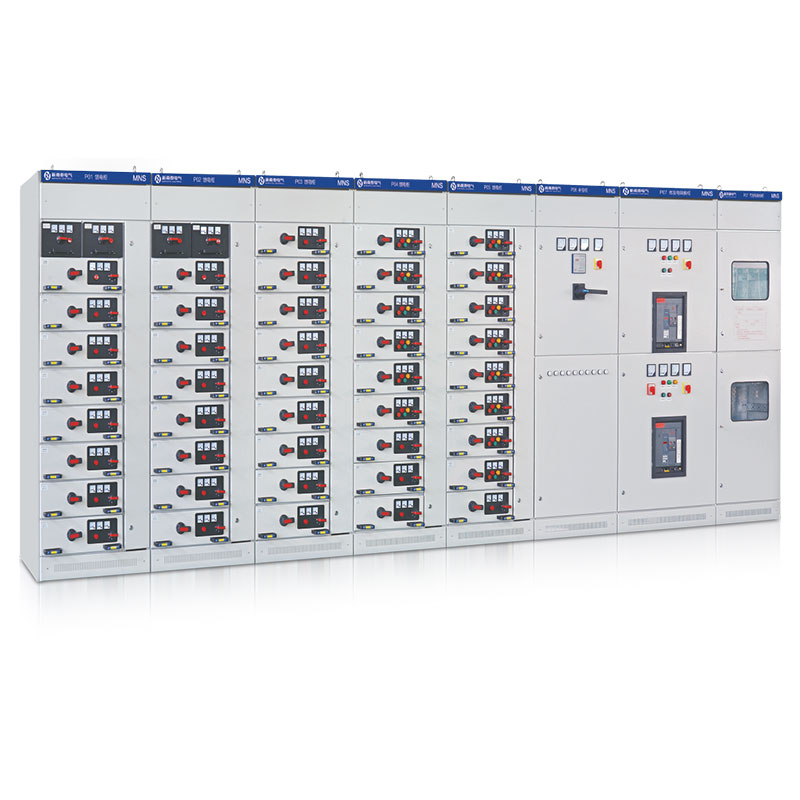
For a floor-standing UPS, plan the installation around four disciplines. Heat: conversion losses must exit the room — at 95% efficiency, a 20 kVA unit at half load still rejects a few hundred watts continuously, and rooms without forced ventilation slowly cook their batteries. Battery environment: VRLA strings tolerate limited temperature excursions but deserve ventilated space and separation from heat sources; lithium banks need their BMS wiring respected and temperature limits honored. Protection and wiring: UPS input, output, and battery circuits each need correctly rated breakers or fuses, short-circuit ratings matched to the upstream board, and a documented maintenance bypass so the unit can be serviced without dropping the load. Distribution: the UPS output is usually a dedicated feeder in the low-voltage distribution cabinet, kept separate from non-critical circuits — our low-voltage distribution cabinet and custom electrical cabinet pages describe how such feeder sections are built, including battery compartments and BESS enclosure work where the storage side grows into a cabinet of its own. And when the backup strategy extends beyond minutes to hours, a generator with an automatic transfer switch takes over — a UPS and an ATS are complementary, not competing, layers.
Frequently asked questions
What is the definition of an uninterruptible power supply?
An uninterruptible power supply is a device that maintains continuous, regulated power to a load during utility failures and abnormalities by drawing on stored battery energy and reconverting it to AC — transferring so fast that the load is unaffected.
What does “UPS” stand for, and what is a UPS unit in practice?
UPS stands for uninterruptible power supply. In practice a UPS unit is a cabinet or wall-mount box containing a battery bank, charger, inverter, and monitoring — anything from a plug-in strip for one computer to a floor-standing 500 kVA system for a process line.
How is a UPS different from a surge protector?
A surge protector only diverts brief voltage spikes to ground; it contains no energy storage and cannot support the load for a single second of outage. A UPS supplies battery power through an interruption and also provides a degree of conditioning — but its internal surge suppression is secondary, so critical installations keep a dedicated SPD upstream. If your concern is spikes rather than outages, start with the surge protection guide linked above.
How do I know what UPS capacity (kVA) I need?
Add up the VA of every supported load (watts divided by power factor), then divide by a 0.8 loading target and pick the next standard rating. A sizing calculator makes this a one-minute job once the load list exists.
How long will a UPS battery backup last?
Runtime follows the ampere-hour balance described above: roughly battery Ah × bank voltage × inverter efficiency ÷ load watts, discounted for high discharge rates and battery age. Most industrial control applications are sized for 10–30 minutes — enough for a safe shutdown or a generator start.
What affects uninterruptible power supply price?
Five factors dominate: topology (double-conversion commands a substantial premium over line-interactive), capacity in kVA, battery chemistry and runtime (lithium and longer runtimes cost more), redundancy (N+1 parallel units), and service ecosystem. The price of the UPS itself is usually smaller than the total cost of batteries and maintenance over its life.
Does a computer system or industrial controller really need a UPS?
Anything that corrupts or scrapes on abrupt power loss benefits: servers and storage, PLCs and HMIs, instrumentation and safety controllers, network and telemetry gear. A useful test is asking what a hard power cut costs your process — if the answer is more than the UPS, the decision is made.
Can a UPS power supply replace a generator?
No — they cover different time horizons. A UPS bridges seconds to minutes with clean power; a generator (with an automatic transfer switch) carries hours of load. Sites that cannot tolerate downtime use both: the UPS holds the load while the ATS transfers it to the generator.
 EN
EN