

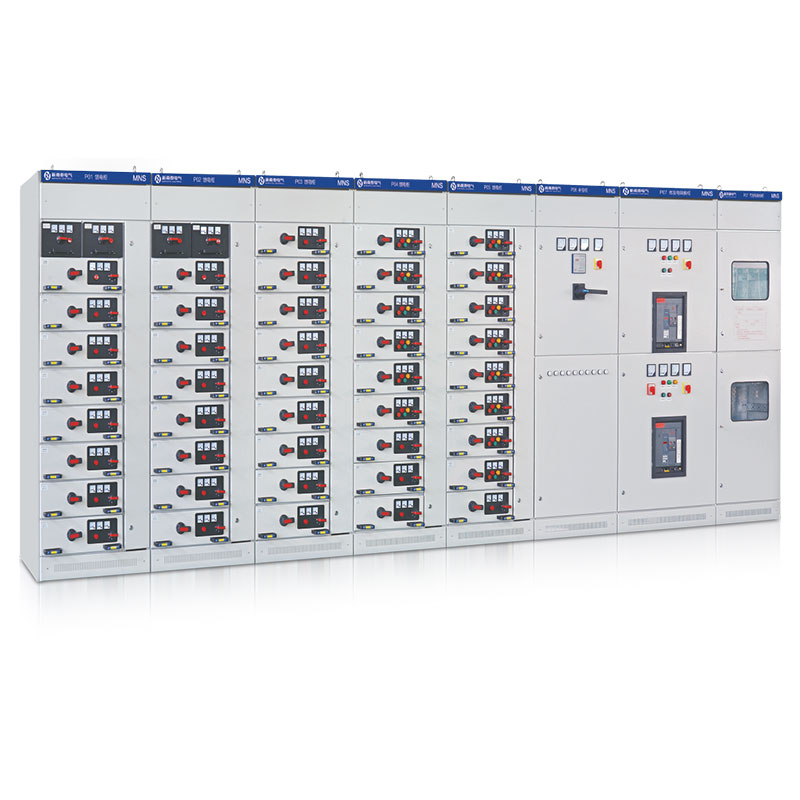


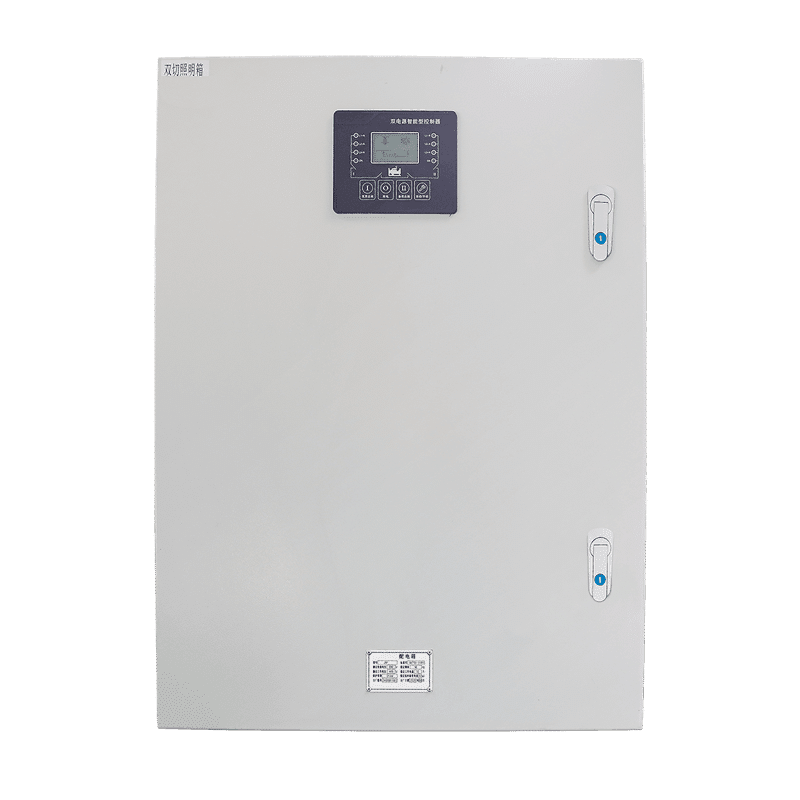




Custom manufacturing automation solutions are engineered systems — sensors, drives, control cabinets, PLC and HMI software, and networks assembled around one specific process — rather than products picked from a shelf. Classifying and buying them well means defining process scope, equipment interfaces, controls, cabinet needs, changeover behavior, service commitments, and project evidence before anything is ordered. This guide gives you the classification framework, the layer-by-layer scope table, the standards that apply, and the acceptance structure that keeps a custom build accountable from first drawing to final site test. It supports design and procurement discussions; final installation, code, safety, testing, cybersecurity, and qualified engineering requirements must be confirmed for the actual project.
What “custom” actually changes
A custom solution earns the word when the engineering content — the I/O list, the control narrative, the interlock logic, the cabinet layout, the drive sizing — is generated for your process rather than configured from a fixed template. That is also where its risks live: every interface between your machines and the new system is an engineering decision someone must own. The discipline that makes custom automation succeed is scope classification: what is included, at which layer, with which evidence, and owned by whom.
The four layers of a custom automation solution
| Layer | Typical content | Engineering evidence to require |
|---|---|---|
| Field devices | Sensors, actuators, valves, drives, motors, instrumented process equipment | Instrument list with ranges and process data sheets; calibration certificates |
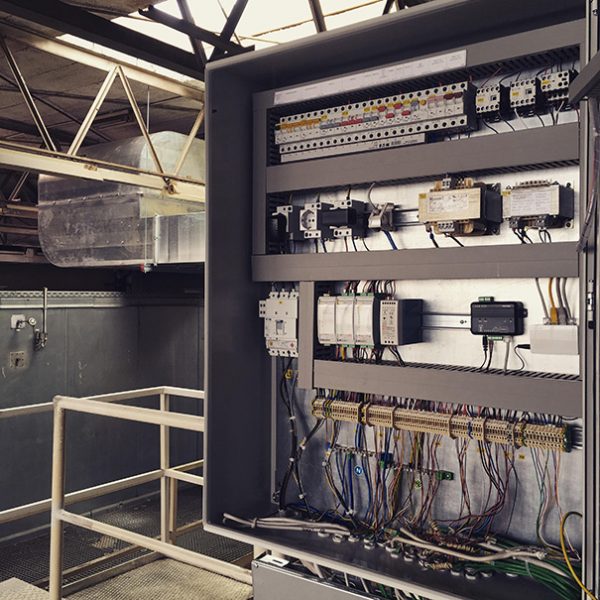
| Control and power | Control cabinets, PLC/DCS, motor control, VFDs, safety relays, distribution | Panel drawings, BOM, SCCR or short-circuit rating documentation, panel standard compliance |
| Software and HMI | Control logic, HMI screens, alarm system, recipes, data logging | Control narrative, I/O and alarm matrices, code under version control, backup strategy |
| Integration and supervisory | Networks, SCADA/MES interfaces, historian, remote access | Network architecture drawing, protocol map, cybersecurity measures, failure-mode behavior |
Define the system boundary
Separate the control cabinet, field devices, PLC or supervisory software, networks, site conditions, and responsible engineering disciplines before selecting a configuration. The recurring boundary questions: who supplies the instruments on existing machines; who owns the code that touches safety functions; who wires between cabinet and machine; and who bears the risk when a legacy device speaks only an obsolete protocol.
Inputs to document
| Input | Why it matters |
|---|---|
| Equipment and interfaces | Sets layout, entries, clearances, signals, power, network paths, and service access. |
| Process and environment | Guides sensor choice, material, heat, corrosion, moisture, and exposure review. |
| Installation and maintenance | Controls mounting, isolation, access, labels, replacement, and service sequence. |
| Validation and records | Defines drawings, testing, alarm checks, software handover, and supplier documentation. |
Do not transfer a competitor automation performance, cybersecurity, safety, or compliance claim to the complete project without project-specific evidence.
Solution families and their risk profiles
| Family | Typical scope | Dominant risk to manage |
|---|---|---|
| Retrofit of existing line | New sensors, control cabinet, and logic over existing machines | Interface discovery on legacy equipment; production loss during tie-ins |
| New machine / skid control | Complete control package built with the machine | Requirement drift between process design and controls design |
| Process upgrading (add measurements, logging, SCADA) | Instrumentation and supervisory layer, minimal control change | Data quality and alarm discipline; network security of new pathways |
| Fully integrated line control | Multi-machine coordination, line PLC, safety system, MES link | Acceptance complexity — needs staged FAT/SAT and interface test matrices |
Acceptance structure that keeps custom builds honest
Structure acceptance in three gates. At design freeze: signed control narrative, I/O list, cabinet general arrangement, and network architecture. At factory acceptance (FAT): the full I/O simulated, alarm matrix demonstrated, safety functions verified with the agreed method, and software backups handed over with the version used in the test. At site acceptance (SAT): repeat the critical tests on real process, demonstrate changeover and recovery scenarios — power loss, network loss, emergency stop — and transfer as-built drawings, parameter files, and a training record. Payments tied to these gates convert “custom” from a leap of faith into an engineering contract.
Standards and frameworks relevant to custom automation
Panel-level compliance follows the market: UL 508A with NFPA 79 in North America, IEC 61439-1/-2 for assemblies in IEC markets, and IEC 60204-1 where the solution is machine electrical equipment. Programmable controllers and their programming languages fall under the IEC 61131 series, which is why structured, documented code is an auditable requirement rather than a courtesy. Safety-related control functions reference IEC 61508 (and ISO 13849 for machinery) with the required integrity level determined by the machine risk assessment — not chosen by the integrator’s preference. Industrial cybersecurity follows the IEC 62443 series for zones, conduits, and security levels, increasingly a contract requirement wherever remote access or MES connectivity exists. The ISA-95 model provides useful vocabulary for where your solution sits between field devices and enterprise systems.
Frequently asked questions
How is a custom solution priced compared with standard products?
Mostly by engineering hours: the I/O count and interface complexity drive design and programming time more than hardware cost does. Two quotations with similar hardware totals can differ widely in engineering content — compare the deliverables lists, not the part numbers.
Should the machine builder or an independent integrator own the controls?
If the machine builder controls well, keeping control with the machine simplifies responsibility; use an independent integrator when coordinating multiple vendors’ machines or when the supervisory layer matters more than any single machine.
What is the minimum documentation set we should demand?
Control narrative, I/O and alarm matrices, electrical schematics as-built, panel photographs, parameter and program backups with version identification, and FAT/SAT records. Anything the maintenance team will need at 2 a.m. belongs in the set.
How do we handle obsolete protocols on legacy machines?
Gateway them at a defined boundary rather than emulating them through the whole system — and test the gateway’s failure behavior explicitly. The follow-up question that matters: what happens to the process when the gateway loses communication, because that behavior should be designed, not discovered.
Is simulation-based FAT acceptable?
Yes and standard for complex systems — with the caveat that simulation coverage must be stated (which signals simulated, which forced), and the SAT must then exercise what the simulation could not.
Procurement scenarios
For a first automation project on a legacy line, start with a bounded pilot: one machine cell, one cabinet, full documentation set, and an agreed expansion path — the pilot’s real deliverable is the discovery of interface reality, and its price buys down the risk of the phases behind it. For multi-market OEMs shipping machines with custom controls, settle the panel compliance path per destination (UL 508A versus IEC 61439) at order stage, since certification lead time — often four to eight weeks — outruns panel build time. For projects under schedule pressure, ask for staged delivery tied to the FAT gates rather than a single ship date, and hold ten percent of payment against SAT completion of the recovery scenarios in the acceptance matrix.
ElectricalCabinet.net delivers custom control cabinets and automation scopes built around your process — see our PLC control panel applications page and HMI-PLC interface planning guide for the component-level detail behind these systems.
 EN
EN