







The 75 kVA transformer is one of the genuine volume ratings: big enough for a serious commercial service or industrial machine group, small enough to remain a catalogue product across every construction — dry-type, oil-immersed, pole-mounted, and pad-mounted. This guide consolidates what buyers of a 75 kVA transformer actually need: the current values at common voltages, the physical and installation picture, the price drivers behind the quotes in front of you, and how to compare them honestly.
Electrical fundamentals at 75 kVA
Line current at three-phase, I = 75,000 ÷ (√3 × V):
| Secondary voltage | Full-load current (3-phase) |
|---|---|
| 208 V | 208 A |
| 240 V | 180 A |
| 480 V | 90 A |
| 600 V | 72 A |
Single-phase 75 kVA at 240 V delivers 312 A — a heavy service, which is why single-phase units at this size commonly feed dedicated equipment rather than general services. Primary-side current depends on the incoming voltage: at 12.47 kV three-phase, a 75 kVA unit draws about 3.5 A. Our kVA-to-amps guide covers the arithmetic and its limits — these are planning values, not conductor sizing decisions.
Impedance at this class typically runs in the ~3–6% band on rating (construction- and standard-dependent; the guaranteed value belongs on your datasheet), setting the secondary fault level your LV protective devices must handle.
The four constructions you can buy at 75 kVA
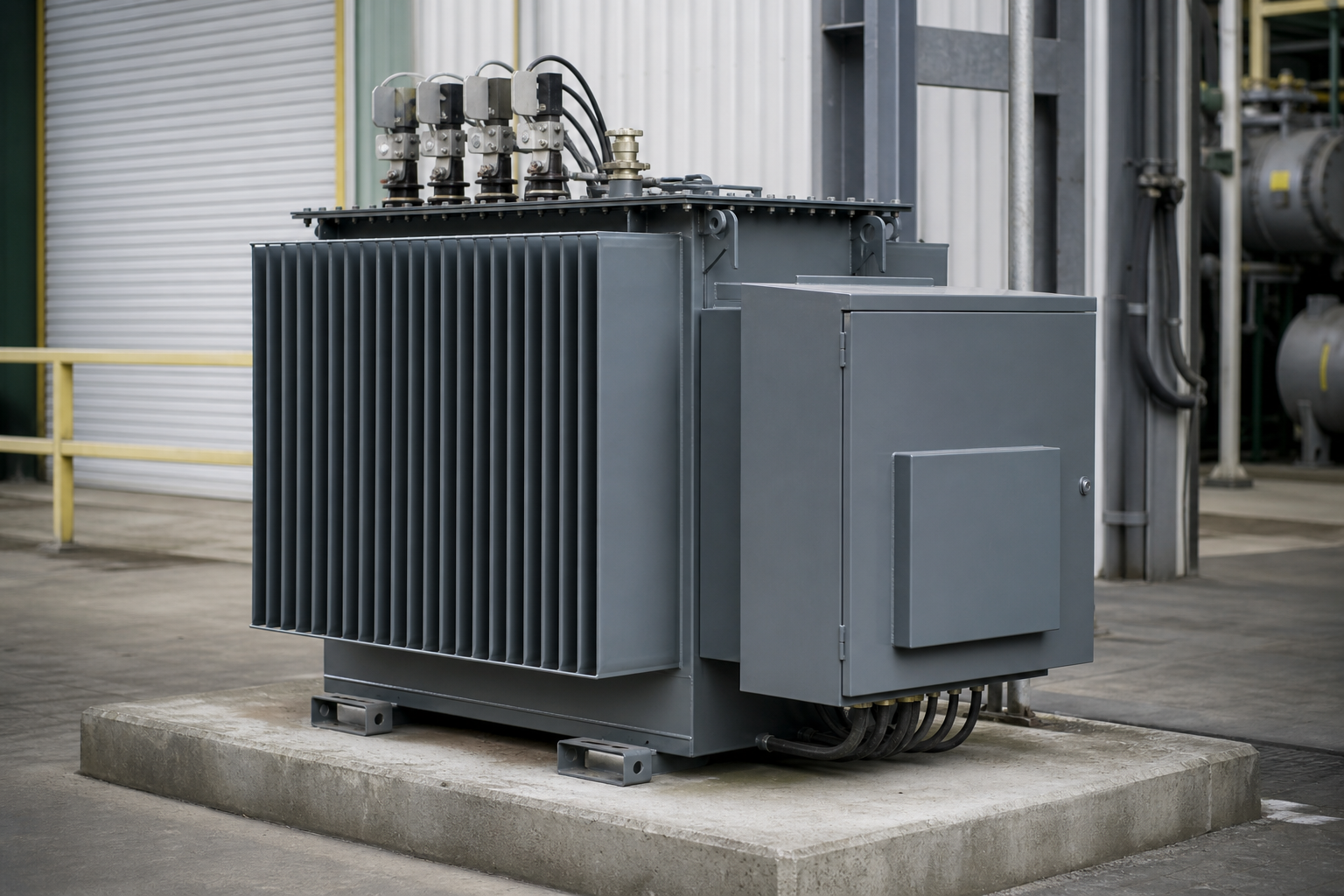
- Dry-type (VPI, ventilated). The indoor standard for electrical rooms: three-phase 480–208/120 V or machine-tool duty. AN-cooled, Class F/H insulation, typically a floor-standing ventilated enclosure of roughly 0.6–0.8 m³ with a mass in the low hundreds of kilograms (unit-dependent — use the manufacturer’s GA drawing for lift planning).
- Oil-immersed pole-mounted. The rural and overhead-network format at single-phase (a volume rating for farm, pump, and small commercial services) or three-phase banks.
- Pad-mounted. Common in underground commercial service at 75 kVA three-phase — the smallest comfortable pad-mount size class.
- Specialty variants. Drive isolation (VFD duty), k-rated (harmonic-rich loads), and encapsulated control units — same nameplate power, different duty engineering.
Price factors: why two 75 kVA quotes differ
At a volume rating, the spread between quotes is rarely arbitrary — it tracks five variables:
- Core material. Amorphous-core units cost more upfront and cut no-load loss by typically 60–70% versus CRGO — a trade that pays where the unit stays energized long hours (most of them do).
- Winding conductor. Copper versus aluminum — a legitimate cost-loss-mass trade, not a quality flag, provided it is declared.
- Loss values and tolerance. Guaranteed no-load/load loss against DOE 2016 (US market) or Ecodesign Tier 2 (EU) floors — better-than-floor loss performance is a priced feature. Compare quotes on total owning cost: purchase price plus capitalized losses over your expected service life and energy price.
- Test depth and documentation. Full routine test report with measured values, compliance documentation, and drawing support versus a nameplate and a prayer.
- Construction and enclosure. Enclosure rating (indoor ventilated vs outdoor), corrosion protection, and terminations move the number materially between “same kVA” quotes.
As a manufacturer, we quote across these variables rather than publish a fixed price — material markets (core steel, copper/aluminum) move, and an honest 75 kVA quotation is built from current inputs, not a stale price list. What you should insist on from any supplier: loss values with tolerance, standards designation, and a per-unit routine test report.
A volume order turns the price factors into program terms. At 3,000 units a year with delivery windows matched to construction phases, the five variables above stop being quote-by-quote comparisons and become standing decisions: the core material choice (amorphous versus CRGO) is a fleet-level total-owning-cost calculation worth real money across that many always-energized units, and the delivery structure — scheduled releases with named slots, documentation batched per phase — matters more than any per-unit discount once the program is running. The suppliers worth shortlisting at this volume are the ones who will commit to loss-value stability across releases, not just a low first-batch price.
Selection and installation notes
- Sizing check. 75 kVA three-phase at 480 V supports roughly 50–55 kW of continuous load at typical power factors, with margin for duty cycles — validate against your demand calculation, not rules of thumb.
- Environment. Dry-type units need their ventilation clearances respected and derate at altitude above 2,000 m and high ambient; outdoor oil units need their corrosion class matched to the site.
- Harmonics. If the load is VFD- or IT-heavy, specify k-rated or derated dry-type construction at ordering — retrofit is not a thing.
- Protection coordination. Fuse or breaker sizing follows the primary current and inrush; record the impedance for the fault study.
FAQ
How much does a 75 kVA transformer cost?
Construction and variables above drive wide spreads (dry-type indoor to pad-mounted utility spec), so a single number misleads more than it helps — request quotations with locked electricals (voltages, impedance, BIL, losses) and compare on total owning cost. The five price factors in this guide tell you where the differences legitimately sit.
Which of the five price factors can be tuned without hurting lifetime cost?
Construction format is set by the installation, so the honest levers are conductor material where your load profile makes the loss math neutral, and monitoring scope — trim instrumentation, not insulation. Core material and loss level tune lifetime cost in the other direction: spending more there usually saves.
How does a 3,000-unit annual program with phased delivery windows change the quote?
Unit prices compress with volume, but the durable value moves into program terms: loss-value stability across releases, named production slots per phase, and per-unit routine test records batched by delivery. A supplier holding those three terms beats a lower first-batch price that drifts by batch three.
Can a 75 kVA transformer be moved without a crane?
Dry-type units in this class are typically rigged with a pallet jack or forklift on a slab; oil-filled pad or pole units need equipment matched to the shipped mass — which is why the GA drawing with masses belongs in the enquiry stage.
What secondary voltages are standard?
Market-dependent: 480 V Δ / 208-120 V Y and 240/120 V combinations in North American practice; 400/231 V in IEC markets — with tri-rated or custom arrangements quoted on request.
Is 75 kVA enough for my shop?
If your connected machinery sums near 40–50 kW with typical duty diversity, yes with margin; motors starting together and future equipment move the answer. Run the demand calculation (see our distribution transformer selection guides) before committing.
Related reading
- 75 kVA transformer calculator — verify the currents and dimensions used here.
- dry-type transformers — the common build path at this rating.
- pad-mounted transformers — the outdoor format where 75 kVA units also serve.
Engineering note: this article is a rating-specific selection reference from ElectricalCabinet.net, a manufacturer of dry-type, oil-immersed, pole-mounted, and pad-mounted distribution transformers plus packaged substations and switchgear. Current values are planning figures; final conductor, protection, and installation decisions require qualified engineering review against applicable codes.
 EN