








Select handheld electronic enclosures using device size, grip, display, battery space, PCB mounting, cable entry, environment, and service requirements. Treat certification and compliance as project-specific evidence; confirm the applicable standard, listing scope, responsible party, and qualified review before release.
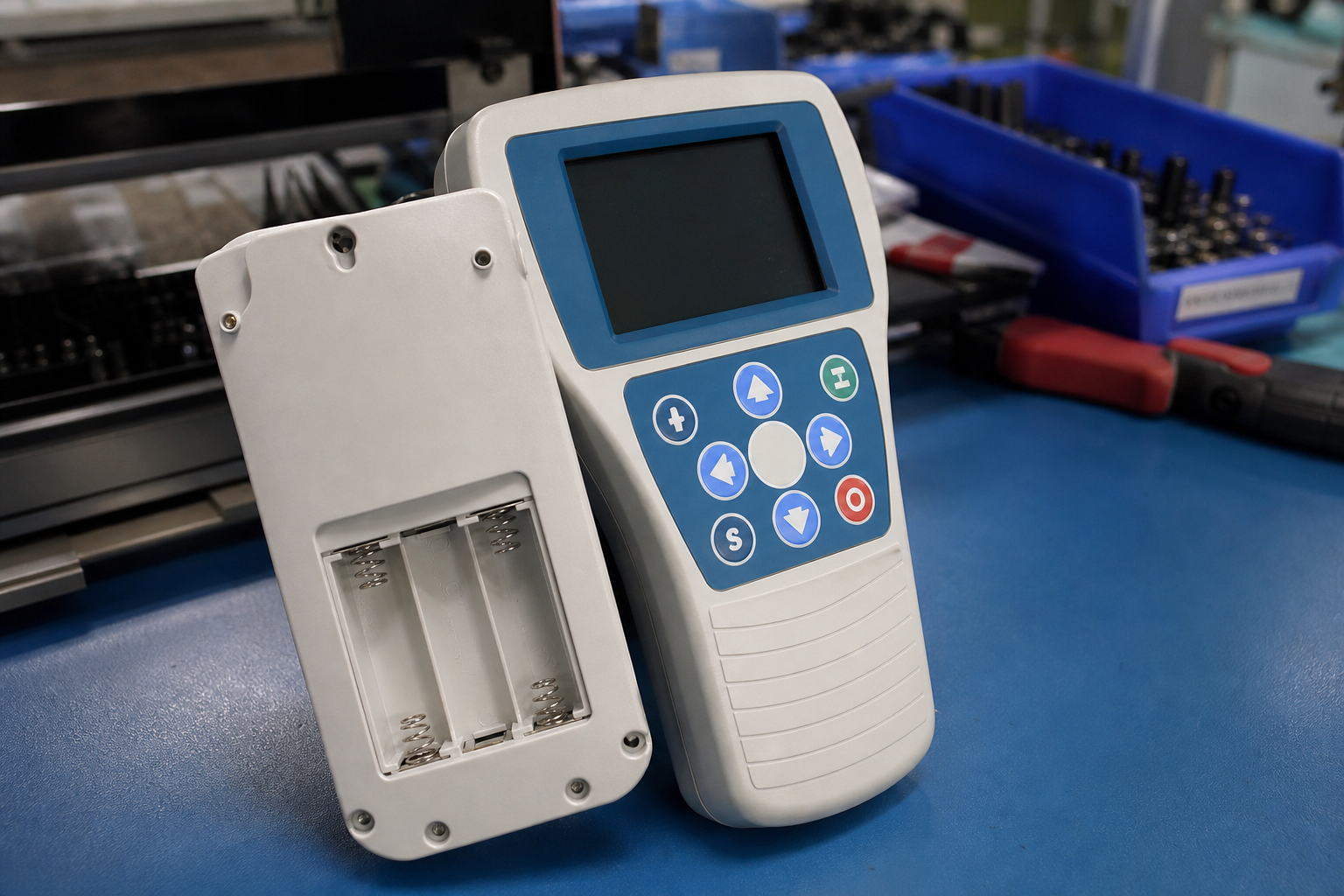
A handheld enclosure is the product. Unlike a cabinet bolted to a wall, a handheld electronic device lives in the operator’s hand – grip comfort, display visibility, button reach, battery access, and drop survival are the enclosure’s core functions, not conveniences. Standard families range from palm-sized instrument cases to two-part shells for data loggers, remote controls, medical devices, and industrial terminals; battery compartments for AA cells or lithium packs, display windows, and keypads dominate the internal layout. Selecting one is a simultaneous mechanical, ergonomic, and compliance decision.
Styles and what they carry
| Style | Typical product | Selection drivers |
|---|---|---|
| Palm / pen-style tube | Probes, moisture meters, laser tools | Diameter for battery stack, window for display, top sensor opening |
| Two-part shell (screwed or clipped) | Data loggers, remote controls, receivers | PCB standoffs, keypad zone, gasket channel for sealing |
| Terminal-style case with display area | Handheld terminals, testers | Display window, keypad cutouts, hand-strap points |
| Rugged overmolded case | Industrial and field instruments | Impact elastomer over rigid core, drop rating, grip texture |
| Wearable / belt-clip variants | Trackers, scanners | Clip retention, battery swap, charging contacts |
Common envelope logic: circuit board outline plus battery footprint plus wall thickness sets the minimum size; everything beyond that is ergonomics – taper for grip, recessed windows for scratch protection, and mass distribution so the device does not feel battery-heavy at one end.
Inputs to document
| Input | Why it matters |
|---|---|
| Physical and electrical layout | Device dimensions, PCB spacing, connectors, battery or power, cable entry, clearances, mounting, and service access. |
| Battery system | AA/AAA user-replaceable cells versus rechargeable packs: access doors, contact design, charging port, transport rules for lithium shipments. |
| Display and controls | Window material (polycarbonate or acrylic clarity and scratch trade-offs), keypad cutouts, backlight heat, sunlight readability. |
| Environment and materials | Heat, moisture, dust, UV, impact, chemical exposure, sealing, material, and cleaning or handling conditions – hand oils and cleaning chemicals are part of the exposure. |
| Drop and impact duty | Field devices get dropped; elastomer overmolds and internal component retention are the countermeasures. |
| Evidence and labeling | Part identity, drawings, material data, test reports, markings, supplier declarations, and limitations of any listing or classification. |
| Verification and handover | Inspection points, assembly checks, test records, manuals, replacement instructions, and unresolved assumptions. |
Do not transfer another supplier’s certification, flame, IP, safety, or performance claim to the complete project without matching evidence.

Materials and sealing in handheld format
ABS and polycarbonate dominate standard cases (PC where impact and temperature lead, alone or as PC/ABS blends), with aluminum for premium shielded instruments and elastomer overmolds for rugged lines. Sealing splits into two strategies: full sealing to an IP rating (gasketed shells, sealed windows and battery doors) versus splash-resistant construction with drain paths. The battery door is the hard part – it is a removable cover on a device that flexes in the hand, so its gasket design and latch retention decide whether the IP54/IP65 claim survives year two. For display windows, polycarbonate trades a little scratch resistance for much higher impact strength versus acrylic; recessed bezels and optional hard-coated grades manage the scratch side.
Standards and certification
- IEC 60529. The ingress code for sealed handhelds (IP54 splash-class to IP67 immersion-class); the rating covers the tested configuration including battery door, windows, and connector covers.
- IEC 62133. Safety of portable sealed secondary cells and battery packs – the battery-system standard behind lithium-product compliance files.
- UN 38.3. Transport testing for lithium batteries – logistics requirement for any shipped pack.
- UL 94. Flammability class of case materials (V-0-class grades commonly specified for electronics in occupied use).
- IEC 61010 / IEC 60601 family context. Where the handheld is a measuring instrument or medical device, the enclosure interacts with the product safety standard’s requirements for accessible parts, marking, and cleaning regimes.
- RoHS / REACH. Declarations for the EU market, including elastomer contact parts.
Frequently asked questions
What IP rating does a handheld device need?
IP54 for indoor and light outdoor use, IP65/IP67 for field instruments exposed to rain or dropped in puddles. Full IP67 with a user-swappable battery door is a design achievement worth paying for – verify the door specifically, not just the shell.
How do I know the device survives drops?
From drop-test evidence: suppliers and product standards test onto hard surfaces from stated heights in multiple orientations. Rugged lines publish this; a thick wall alone is not data.
Why does the display window material matter so much?
It is the most-touched surface and the main scratch and UV exposure. Polycarbonate gives impact and clarity; hard coats or acrylic alternatives trade between scratch and shatter behavior – the choice follows the duty profile.
Can I machine a standard case for connectors and displays?
Milling, drilling, and display cutouts are routine for standard enclosure lines – but modifications sit outside the tested ingress configuration, so revalidate sealing for rated products or use factory-machined variants.
What about EMI in a handheld device?
Handhelds live next to radios, motors, and other phones: the enclosure contributes shielding only in metal or metallized versions, while the plastic-bodied standard answer is layout discipline – keep antennas clear, segregate switching circuits, and prove the assembly against the relevant immunity and emission limits rather than expecting the shell to solve it.
What should the supplier provide for a medical or industrial handheld?
The full evidence chain: material datasheets (including cleaning-chemical compatibility), ingress test configuration, flammability class, battery-system standards where applicable, and the limits of each claim. See our guide to reading UL evidence for the listing-versus-recognized distinctions that recur on handheld assemblies.
Ordering scenarios
An OEM building 2,000 environmental data loggers would specify a two-part gasketed shell in PC/ABS, IP65-class sealing with a documented battery-door design, recessed hard-coated display window, PCB standoffs matched to the layout, and RoHS/REACH plus battery-transport documentation for global shipment. An industrial-connector maker launching 500 field service terminals instead chooses a rugged overmolded case family with drop evidence, IP67 shell, replaceable keypad membrane, and accessory options (belt clips, lanyards) – ordering by envelope drawing and evidence file rather than catalog photo.
 EN
EN