

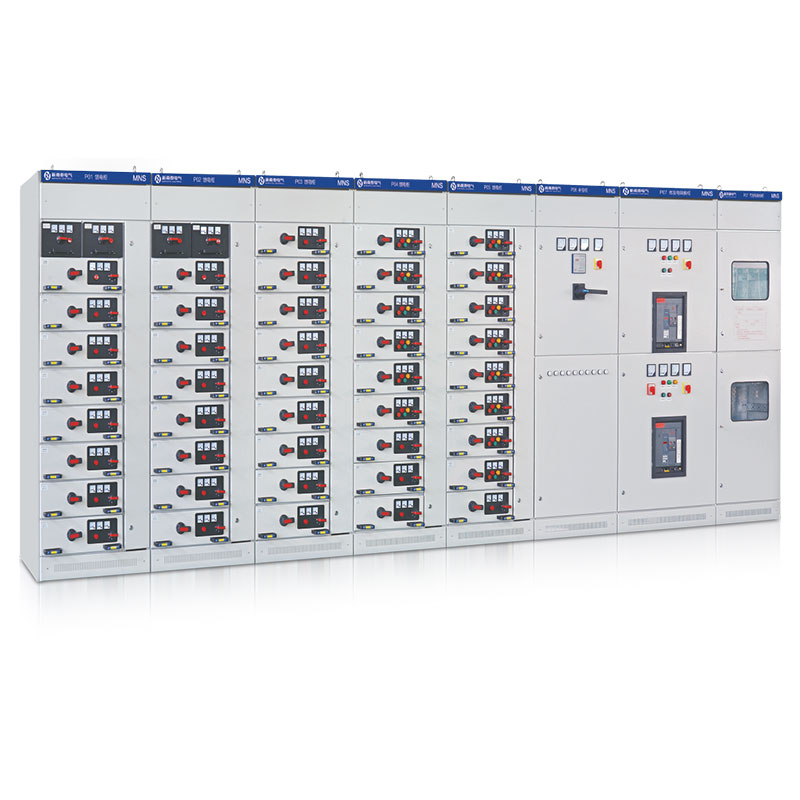






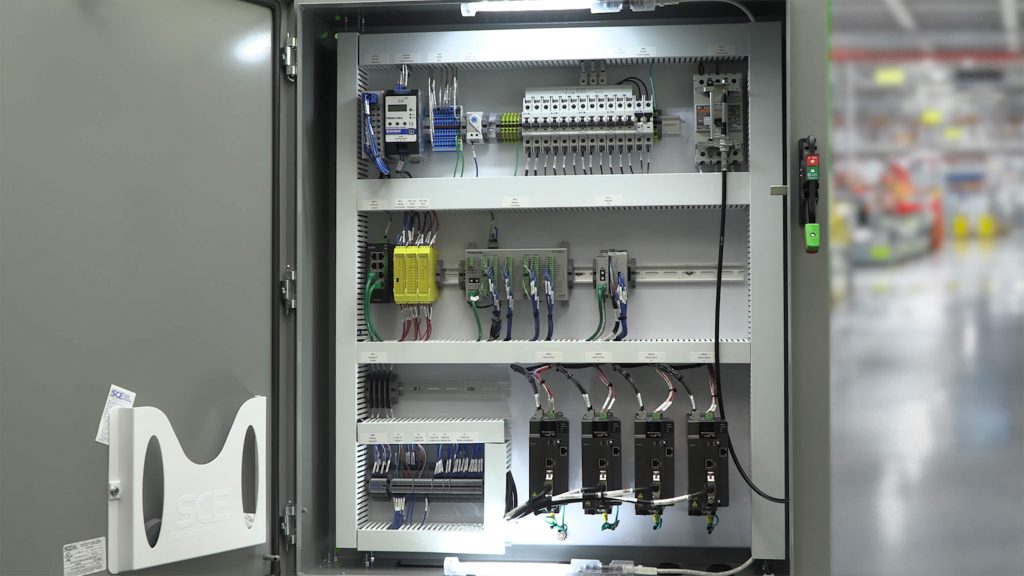
Every industrial project eventually sends a control panel enquiry into the market, and the search for control panel manufacturers usually starts after a spec has been roughly sketched: a PLC or VFD lineup, a motor list, an environment, a delivery date. What separates a painless order from a commissioning nightmare is rarely the brochure — it is the manufacturer’s wiring discipline, testing depth, and documentation habit. Those are observable before you pay anything, if you know where to look.
We build industrial control panels (PLC, VFD, motor control, and distribution) for export OEMs and plant projects. This is the evaluation framework we would apply to any panel shop — including our own — before placing a build.
Define your panel before you ask for quotes
Vague enquiries produce safe, padded quotes — or cheap, wrong ones. Prepare:
| Input | Why it changes the quote |
|---|---|
| Load/motor schedule with ratings | Determines breaker, contactor, overload, and VFD sizing |
| Control architecture (PLC/DCS/relay logic) and I/O count | Drives enclosure size, layout, and 24 V DC supply sizing |
| Environment (temperature, washdown, dust, corrosive, outdoor) | Material (mild steel / 304 / 316L / composite), rating (NEMA 12 / 4X / IP66), climate control (heater, filter fans, A/C) |
| Applicable standard and market | UL 508A for North America, IEC 61439-2 for CE markets — components and creepage/clearance rules differ |
| SCCR requirement | Fault level at the panel supply determines the short-circuit current rating the assembly must carry |
| Terminal strategy | Field terminals on top or bottom, cable sizes, gland quantities and types |
A manufacturer who helps you close gaps in this list is already demonstrating the engineering value you are actually buying.
The five evaluation dimensions that predict panel quality
1. Certification scope. For the US market, a UL 508A certified panel shop is effectively mandatory for field acceptance in most jurisdictions; verify the certification is current and covers industrial control panels (the certificate names the category). For IEC markets, ask how the manufacturer executes IEC 61439-2 design verification — by test, by calculation, or by comparison to a verified reference design — and ask to see the file.
2. Wiring workmanship (inspect a sample panel, in person or by video). The tell-tale standards of a professional build: consistent wire colors by function (e.g., red for AC control, blue for DC, blue-with-white stripe for neutral-bonded DC), ferrules on both ends, dedicated equipment-grounding conductor in green/yellow, wire duct fill below ~70%, and separation between power and signal wiring. Torque marks on breaker and busbar terminals indicate a documented tightening procedure — a small detail that directly correlates with field reliability under fault current.
3. Component policy. Ask which brands they stock and how they authenticate them (authorized distribution only, batch traceability, and what they do during global shortages). Gray-market breakers and VFDs are a real problem in the price-driven segment of this industry. Also check whether they propose plated, traceable terminal blocks rather than unbranded commodity hardware on a panel that carries a 10-year service life.
4. Test depth. Minimum acceptable: 100% continuity verification against drawings, insulation resistance test (typically 500 V DC megger on control wiring, with recorded values), and a functional simulation of the control logic with inputs forced and outputs observed. For VFD panels: parameter backup file delivered with the panel. Anything less means you are commissioning at your own site what should have been caught at the factory.
5. Documentation package. As-built schematics (EPLAN or AutoCAD Electrical native files if you need them), BOM with manufacturer part numbers, panel layout drawings, test certificates, and operating instructions. Reordering or modifying a panel in five years depends entirely on this package existing.
Commercial and delivery structure
- Lead times: standard-configuration panels in 2–4 weeks; engineered custom panels 4–8 weeks including drawing approval cycle; add 2–3 weeks when UL file review or third-party FAT applies. Drawing approval is the milestone where most schedules are actually won or lost — respond to drawings within 48 hours and you protect the production slot.
- MOQ and NRE: custom panels carry one-time engineering (drawings, programming, test plan) that a professional quote separates from unit price. On repeat OEM volumes this amortizes to near zero; for one-offs it is the honest cost of doing it right.
- Capacity: a mid-size panel manufacturing line typically outputs 100–400 cabinets per month; ask about current line load and how your order is scheduled (engineering hours and test bench time gate output more than assembly labor).
- Warranty and support: standard terms in this industry run 12–24 months on the assembly, with component warranty passing through from the component maker. The differentiator is response: who answers the commissioning call, in what time zone, and whether spare PLC programs and parameter files are archived for your panels specifically.
Constraints sharpen the shortlist. If your first order is only 50 panels for a UL 508A market project and the machine sequence is fixed, focus the audit on panel shops holding current UL 508A certification with a repeat-OEM track record — the certificate names the facility, and the follow-up inspection regime is what keeps unit 40 identical to unit 1. Where the same design also ships to CE markets later, ask up front how the manufacturer maintains parallel UL 508A and IEC 61439-2 design files: creepage, clearance, and component-suitability rules differ, and a shop that re-engineers per market instead of maintaining both files will bleed schedule. A 20-day custom build inside that window is realistic only for a production-ready design with frozen BOM — treat it as a screening question, not a demand.
FAQ
What is the difference between a control panel manufacturer and a panel builder?
Functionally overlapping terms; “manufacturer” implies in-house sheet-metal fabrication and larger-scale production, while “panel builder” often means a shop assembling components into bought-in enclosures. Both can be excellent. The evaluation criteria above apply to either — judge evidence, not the label.
Should the panel manufacturer program the PLC?
Let them if your sequence is well-defined; keep it in-house if the logic is still evolving mid-build (late software changes are the top cause of rework disputes). Either way, define in the contract who owns the source code and who delivers the final commented version.
How much spare capacity should I specify in the panel?
Common practice: 10–20% spare I/O points wired to terminals, one or two spare DIN rail sections, and 20% spare ampacity on distribution breakers. It costs little at build time and is expensive to retrofit.
How does spare capacity interact with enclosure size and unit price?
Spare I/O and DIN sections push the enclosure one size up and add terminals, which is where the cost sits — typically a low single-digit percentage of panel value. The honest trade is against thermal margin: more volume also means better cooling.
Does that trade change on a 50-unit UL 508A first order?
Slightly, in favor of specifying spares: at 50 units the enclosure tooling and drawing set amortize across the batch, so the marginal cost of the larger enclosure falls, while a field retrofit across 50 installed panels stays fully priced.
Enquiry checklist
Send your enquiry to two or three manufacturers and compare against this list: scope alignment (same components and ratings), certification evidence, test protocol, documentation deliverables, delivery structure with milestones, and the quality of the questions they asked you. The last one is the best predictor — manufacturers who interrogate your specification are the ones who will not improvise during your build.
Related reading
- electrical control panel guide — panel fundamentals from the component level up.
- industrial control panel design standards — the UL/IEC standards landscape manufacturers build to.
- control panel product line — our manufacturing scope for standard and engineered panels.
Engineering note: ElectricalCabinet.net is a manufacturer of industrial control panels, PLC/VFD assemblies, and LV switchgear for OEM and project customers. This guide is an evaluation framework, not a substitute for project-specific engineering review.
 EN
EN