







A transformer is a 20-to-30-year asset that everything downstream depends on. When it fails, the conversation is never about the transformer — it is about the production line, the data center, or the utility feeder that went dark. That is why searching for transformer manufacturers is really a search for design and test capability, not a product: the unit that quotes lowest and the unit that survives three decades of load cycles, harmonics, and short-circuit events are separated by things you cannot see on a datasheet — core material discipline, winding tension control, insulation processing, and the depth of the factory test floor.
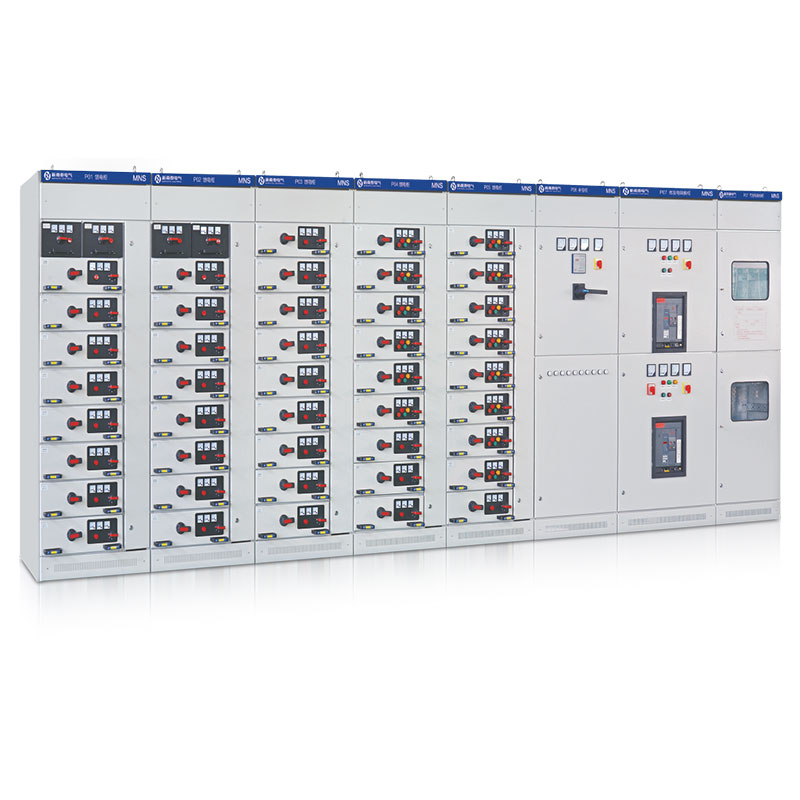
As a manufacturer of distribution transformers, dry-type units, and packaged substations — alongside the switchgear and control assemblies they connect to — we handle these enquiries daily. This guide lays out the evaluation framework our own customers apply, and that we recommend you apply to any supplier, including us.
First decision: which manufacturer segment actually fits your enquiry
Not every transformer manufacturer serves every product family. Segment your enquiry before you shortlist, because a supplier quoting outside their core line is learning on your project:
| Segment | Typical scope | Voltage / rating range | What to verify |
|---|---|---|---|
| Distribution transformer makers | Oil-immersed and dry-type units for MV/LV distribution | 10–36 kV class primary, 25–2,500 kVA (up to 10 MVA special) | IEC 60076 or IEEE C57 design basis, short-circuit type test |
| Power transformer makers | GSU and transmission interconnection | 72.5 kV and above, 10–100+ MVA | Full type-test portfolio, transport and site assembly capability |
| Specialty / custom shops | Drive isolation, k-rated, Scott-connection, high-reactance units | LV/MV custom ratings | Engineering review process, UL 5085 or IEC compliance path |
| Instrument transformer makers | CTs / VTs for metering and protection | 0.6–36 kV, ratios and accuracy classes | Accuracy class certificates, IEEE C57.13 / IEC 61869 conformity |
Most enquiries we route are distribution-class (pad-mounted, pole-mounted, dry-type) and specialty industrial units — and a manufacturer who honestly tells you “that rating belongs on a power transformer maker’s floor, not ours” has passed the first credibility test.
The capability ladder: assembler vs winding shop vs verified manufacturer
The commercial consequence of the difference appears at energization, at every short-circuit event, and at year 15:
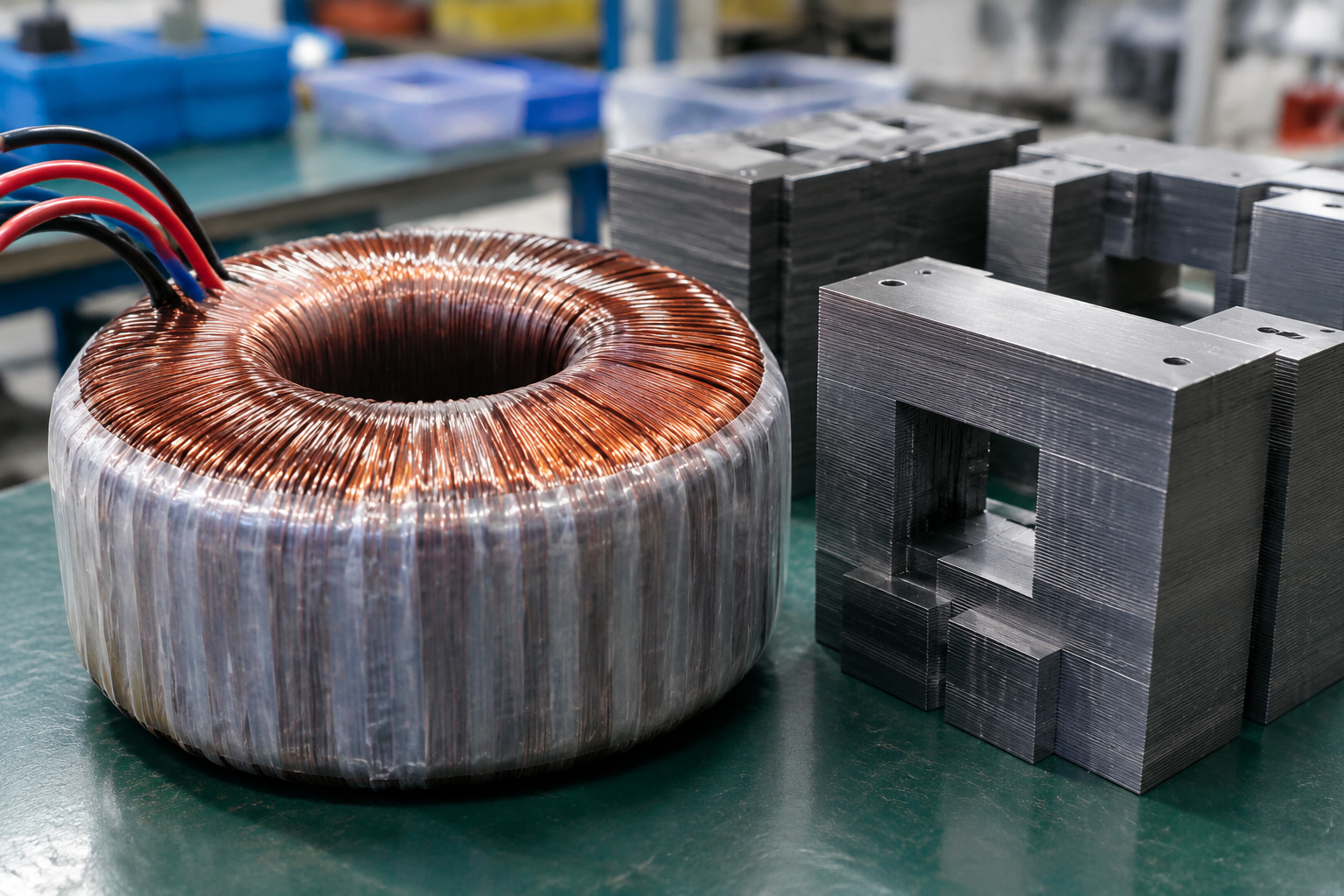
- Core processing. Step-lapped core joints, controlled cutting, and amorphous or CRGO grade selection determine no-load loss and noise. Ask what core materials the plant is qualified to process, and what no-load loss tolerance it guarantees (a ±10% tolerance on a quoted loss value is a normal ask).
- Winding discipline. Tension-controlled winding, conductor insulation class (F/H for dry-type per IEC 60076-11), and transposition on multi-parallel conductors decide how the unit survives thermal cycling and through-faults.
- Insulation and curing. For cast-resin units: vacuum casting lines with documented process parameters. For oil units: moisture control during assembly and vacuum oil filling. A plant that cannot describe its vacuum process is assembling, not manufacturing.
- Short-circuit withstand evidence. The winding must survive rated through-faults. Ask for the IEC 60076-5 short-circuit type-test report covering a design family close to your rating — this is the single most frequently faked or omitted document in the industry.
- Test floor depth. A routine test set covering ratio, polarity, winding resistance, no-load and load loss (by impedance), induced and separate-source withstand, and for oil units oil dielectric and DGA baseline. Sound-level measurement per IEC 60076-10 when noise is contractual.
Standards and compliance routes to request
Ask for certificates with report numbers and scopes — not website logos:
- IEC route: IEC 60076 series design conformity (Part 1 general, Part 3 insulation levels, Part 5 ability to withstand short circuit), routine test records per unit, and type tests from an accredited laboratory (KEMA-CESI, ASTA, CPRI, or CNAS-accredited national labs).
- North American route: IEEE C57.12.00/C57.12.90 for oil units, C57.12.01/C57.12.91 for dry-type; DOE 2016 minimum efficiency compliance (10 CFR 431) for covered distribution transformers; UL recognition (UL 1561 dry-type general purpose, UL 5085 low-voltage, UL 1562 medium voltage dry) where the installation requires it.
- EU route: CE marking under the Low Voltage Directive, plus Ecodesign Regulation (EU) 548/2014 Tier 2 peak-efficiency values for distribution ratings sold into Europe.
- Quality system: ISO 9001 with a certificate scope covering transformer manufacturing — not a trading scope.
Verify authenticity where stakes justify it: UL certifications are searchable in Product iQ; accredited-lab report numbers can be confirmed with the issuing body. Fabricated test reports circulate in this market, and discovering one at site acceptance transfers the full cost to you.
Delivery, capacity, and the realities of custom units
- Lead times: standard dry-type distribution ratings typically ship in 4–8 weeks; oil-immersed and pad-mounted utility-grade units commonly 8–14 weeks; amorphous-core and specialty engineered units can run longer because core material supply and engineering review sit on the critical path. A promise of a custom 2 MVA unit in two weeks deserves scrutiny.
- Capacity signal: mid-size transformer plants commonly deliver tens to a few hundred distribution units per month; what matters is whether your delivery window is protected in the production plan, and whether the plant holds backup core-material supply (CRGO and amorphous ribbons are globally traded commodities with real allocation cycles).
- Component traceability: bushings, tap changers, relays (Buchholz, WTI/OTI), and protection devices should come from named brands with batch traceability. Ask how second-source qualification is handled when a bushing supplier has a backlog.
- FAT discipline: insist on a written factory acceptance protocol — ratio and vector group verification, loss measurement, withstand tests, functional check of protection devices, and dimensional review — and attend it or send a third-party inspector for anything above 1 MVA.
Order shape steers the screening. If your first order is only 50 units for an IEC-market project with energization dates back-planned from a construction program, weight two things above price: which short-circuit type-tested design family (IEC 60076-5) covers your exact kVA and voltage — with a report number the issuing lab will confirm — and how the factory protects your production slot when core-material allocation tightens. Fifty units is enough to justify a witnessed FAT on the first article and per-unit routine test records across the batch, yet not enough to command material priority on its own; the manufacturers worth shortlisting are the ones who say that out loud and show you where your order sits in the monthly plan.
Questions that predict the next ten years
- Will you re-make this design in five years with the same loss values, and will the drawing package be retained?
- What is the guaranteed loss tolerance, and is no-load loss measured on every unit or sampled?
- How do you handle HV winding replacement or repair — in plant, on site, or not at all?
- Which spare parts should be held at commissioning, and what is the obsolescence plan for relays and bushings?
- Is site commissioning, oil filling (for shipped-unfilled units), and testing included or excluded?
FAQ
Why do quotes for identical kVA and voltage differ by 30–50%?
Loss capitalization is the hidden driver: a unit with lower no-load and load losses costs more to build and less to run. Other drivers include core material grade (amorphous vs CRGO), copper vs aluminum windings, and whether type-test evidence actually exists. Compare quotes on total owning cost, not purchase price.
Which of those drivers can be tuned without shortening service life?
Core material and loss level are lifetime decisions — tune them against your tariff, not your budget. The honest adjustable items are monitoring scope, enclosure options, and conductor material where the load profile leaves the loss math genuinely neutral.
How does a 50-unit first order into an IEC market with back-planned energization change the screening?
Add two gates: the IEC 60076-5 type-test family covering your ratings (report number verifiable), and a written production-slot commitment per delivery phase. Loss tolerance and routine test records still apply per unit — volume never waives them, it only multiplies the paperwork.
Should I buy the transformer from the same manufacturer as the switchgear?
Evaluate each on its own evidence — but a supplier producing both transformers and the LV/MV assemblies they connect to reduces interface risk (cable box coordination, protection settings, grounding, unified documentation), which is why we build packaged units both ways.
Is a type-test report on one rating valid for mine?
Type tests verify a design family within declared design constraints. A report on a 1,000 kVA unit does not automatically cover your 2,500 kVA — ask which family your rating falls into and see the routine test records for every manufactured unit.
RFQ checklist before you send the enquiry
- Rated power, voltage ratio, phases, frequency, vector group and impedance (or ask the manufacturer to propose)
- Installation: indoor/outdoor, ambient, altitude above 2,000 m, corrosion or seismic requirements
- Load profile: harmonics (k-factor need), motor starting duty, unbalance, future expansion margin
- Applicable standards regime (IEC / IEEE / UL / DOE / EU Ecodesign) and witness-test requirements
- Loss values offered and tolerance, sound level limit if the site is noise-sensitive
- Documentation deliverables: test certificates, GA and winding drawings, instruction manual, Declaration of Conformity
Related reading
- transformer kVA calculator — size the rating before comparing supplier quotes.
- dry-type transformers — the indoor-friendly build path many buyers end up specifying.
- oil-immersed transformers — the liquid-filled alternative for outdoor duty.
Engineering note: this article is a procurement evaluation framework from ElectricalCabinet.net, a manufacturer of distribution transformers, packaged substations, and LV/MV switchgear and control assemblies. Final ratings, protection settings, and compliance decisions for any project require qualified engineering review against the applicable installation codes.
 EN
EN