







Toroidal and EI transformers are the two dominant laminated-core constructions for control, isolation, and low-power applications, and the choice between them is an engineering trade: toroidals offer higher efficiency, a lower external stray field, lower audible hum, and a compact shape — at the cost of a famously high inrush current at energization, more delicate mounting, and poorer tolerance of DC bias and mechanical abuse. EI cores trade some efficiency and size for ruggedness, lower inrush, easier shielding and mounting, and generally lower cost at small ratings. This guide compares the two constructions on the dimensions that drive selection — construction, heat, noise, magnetics, wiring, enclosure space, duty, and the evidence to demand from suppliers — so the choice follows application physics rather than catalog photographs. Final installation, code, safety, rating, and testing requirements must be confirmed with the responsible qualified engineer.
Construction: why the differences follow from the geometry
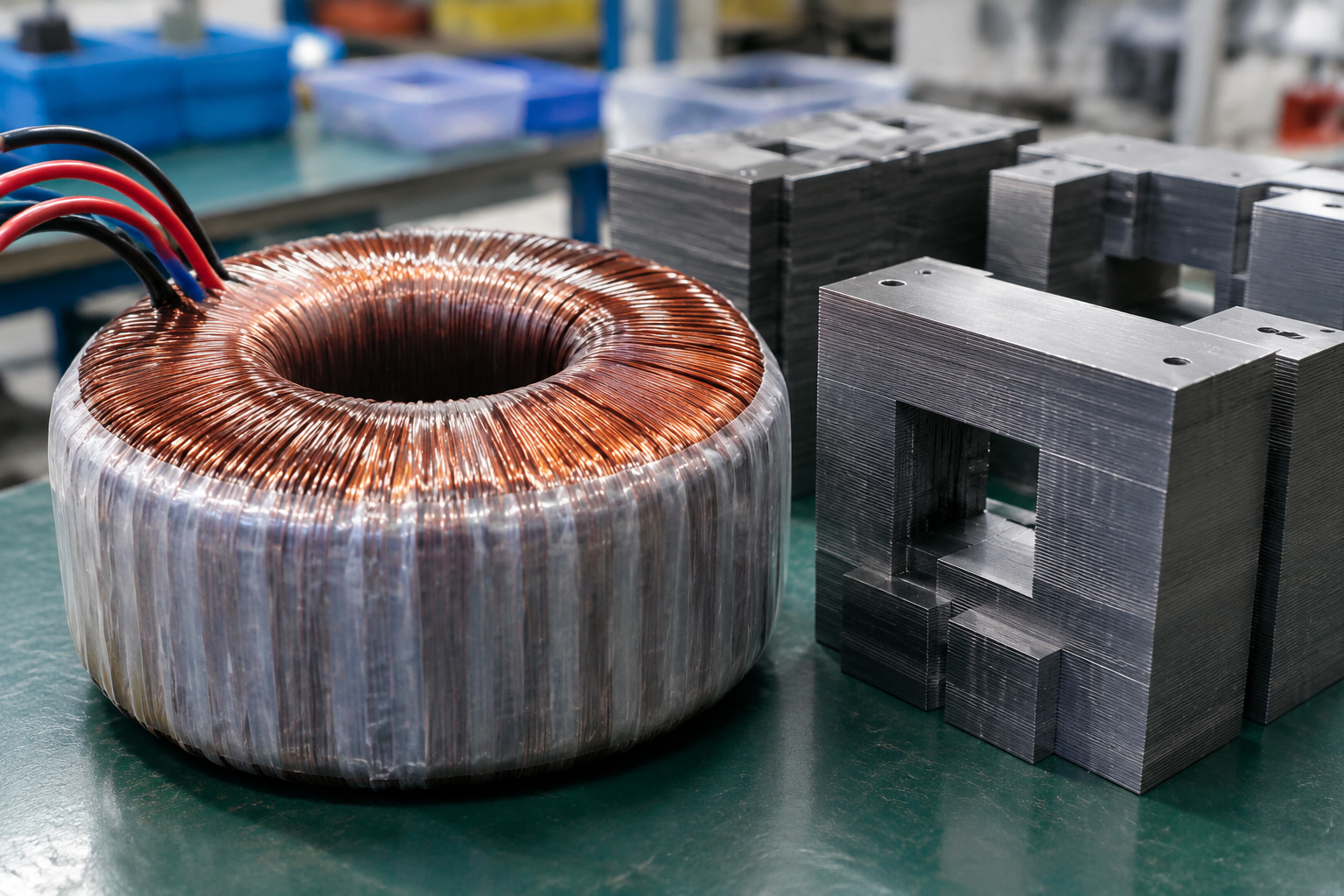
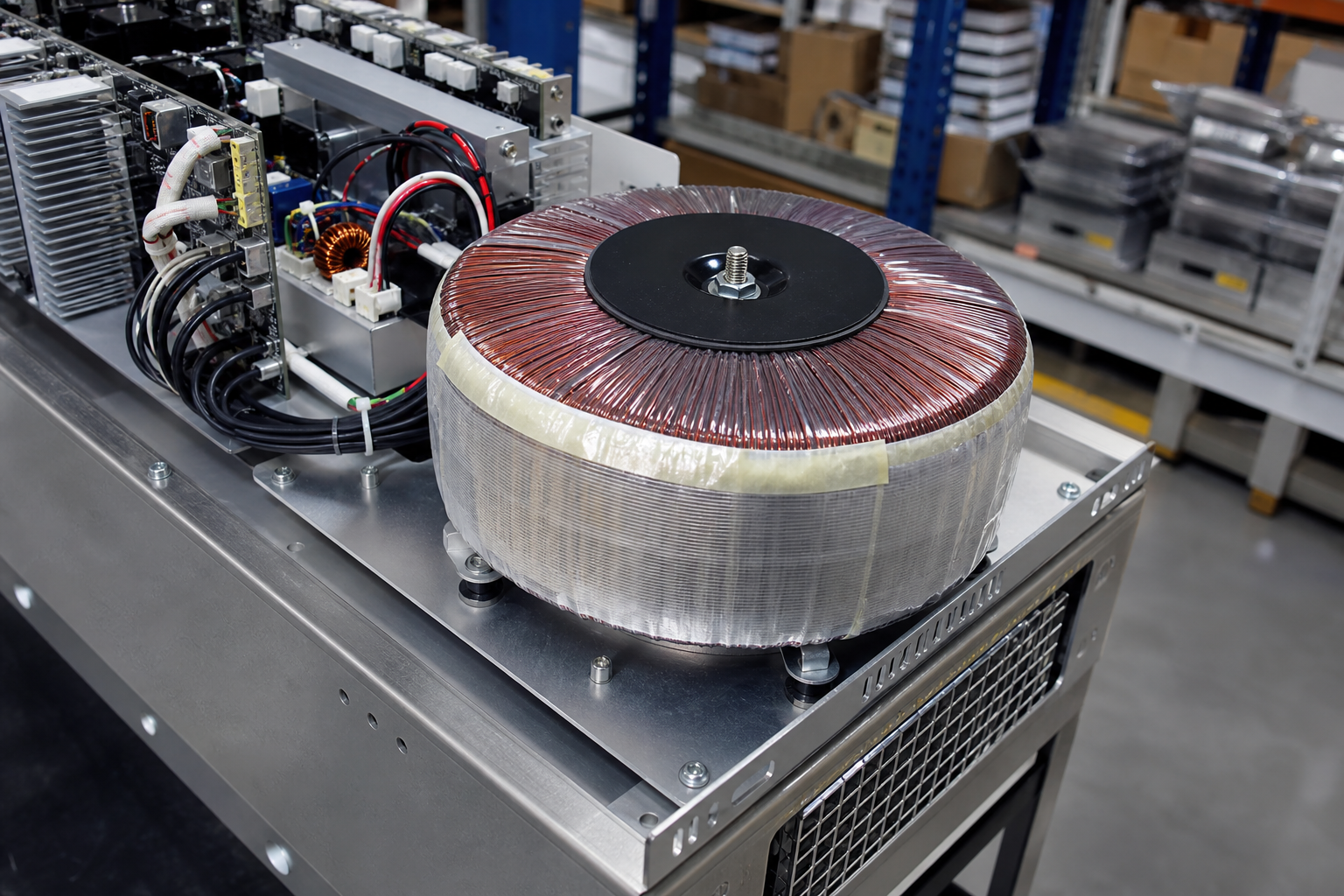
An EI core stacks punched laminations in the familiar E-and-I shapes, with the coil wound on the center limb; the assembly inherently contains small air gaps at the lamination joints. A toroidal core is a continuous strip of grain-oriented steel wound into a ring, with the winding wrapped around the ring itself. The closed magnetic path makes the toroid more efficient magnetically and quieter — no lamination joints to buzz — but also means very low residual magnetizing inductance difference at switch-on: energizing at the wrong point on the voltage wave with residual flux in the core can saturate it briefly, drawing an inrush current many times the rated current. That single physical fact explains most of the practical selection rules below.
The comparison
| Dimension | Toroidal | EI (laminated) |
|---|---|---|
| Typical efficiency | Higher at small-medium ratings | Lower; losses higher at same rating |
| External stray field | Low — flux stays in the ring | Higher; may need shielding near audio and sensitive circuits |
| Audible noise | Low — no lamination joints | Higher hum under load |
| Inrush at energization | High — can reach many multiples of rated current | Lower — joint gaps limit saturation depth |
| DC bias tolerance | Poor — small DC unbalances the ring’s magnetization | Better — gaps absorb some asymmetry |
| Mechanical robustness | Lower — wound ring needs careful center mounting | High — rugged, forgiving of vibration environments |
| Mounting | Single center bolt; must not form a shorted turn around the core | Bracket or clamp mounting; conventional |
| Shape efficiency | Compact, low profile; fits tight enclosures | Bulkier for same rating |
| Cost at small ratings | Often higher | Often lower |
| Custom winding flexibility | Excellent — multiple secondaries, dual primaries common | Good but more tooling-bound |
Selection by application physics
Choose toroidal where efficiency, low stray field, low hum, or a compact envelope dominate: audio and instrumentation power supplies, medical and measurement electronics, control transformers in noise-sensitive panels, and low-profile encapsulated designs. Choose EI where the environment and the electrical supply are hostile: panels with heavy inrush-sensitive breakers upstream, loads imposing DC asymmetry, vibration and rough handling, and cost-driven volume production. The inrush dimension deserves explicit circuit design: toroidals upstream of fast magnetic protection may trip breakers at energization, so slow-technology protection or inrush limiting belongs in the design — a classic systems detail that no transformer datasheet resolves for you.
Mounting and installation notes
A toroid mounts through its center with a non-conductive or properly isolated bolt arrangement; a metal strap or bolt path that completes a loop around the core creates a shorted turn, overheating the unit. EI units tolerate ordinary panel brackets. Both constructions need clearance for convection and, at larger ratings, derating for enclosed installation — enclosure space and heat, not just footprint, belong in the selection table. Potting or encapsulation variants trade a little thermal performance for environmental protection and are the standard answer in dusty or humid panels.

Define the system boundary
Separate the enclosure, connected equipment, source and load interfaces, site conditions, and responsible engineering disciplines before selecting a configuration.
Inputs to document
| Input | Why it matters |
|---|---|
| Equipment and interfaces | Sets layout, entries, clearances, power paths, signals, and service access. |
| Environment and duty | Guides material, sealing, heat, corrosion, moisture, and exposure review. |
| Installation and maintenance | Controls mounting, isolation, access, labels, replacement, and service sequence. |
| Validation and records | Defines drawings, inspection, testing, interlocks, and supplier documentation. |
Do not transfer a competitor performance, protection, current, or certification claim to the complete project without project-specific evidence.
Standards and verification
Small-power and control transformers certify under the IEC 61558 series (safety of transformers, reactors, and power supply units) or UL 5085 for low-voltage transformers in North American listings, while larger dry-type units graduate to the IEC 60076-11 and IEEE C57 dry-type families. The verification conversation mirrors any transformer purchase: nameplate ratings matching the ordered specification, routine test evidence (turns ratio, no-load and load loss where applicable, dielectric tests), and construction data — core material class, insulation system temperature class, and encapsulation grade where the environment demands it. For custom windings, the winding data sheet (primary/secondary voltages, VA, regulation, temperature class) is the document that makes a custom order repeatable; require it as a deliverable.
Frequently asked questions
Why does my toroidal transformer trip the breaker at switch-on?
Inrush: energizing at an unfavorable point on the voltage wave saturates the low-loss core briefly, and the current spike trips fast magnetic protection. Fix it in the design — inrush limiting, softer protection technology, or a slow-start circuit — not by upsizing the transformer.
Are toroidals always the premium choice?
No — in environments with vibration, DC offset risk, or brutal cost targets, EI construction is the engineering answer. Toroidals win on efficiency, noise, and stray field; EI wins on ruggedness, inrush behavior, and price at small ratings.
Can I mount a toroid with a metal bolt?
Yes, if the bolt arrangement does not form a closed conductive loop around the core — the mounting hardware and any clamp plate must be isolated so no shorted turn exists. Follow the manufacturer’s drawing; this is the single most common toroidal installation error.
Which is better for audio?
Toroidals, for their low hum and low radiated stray field — though some designs add an EI or R-core where mechanical noise immunity matters more.
Do toroidals work on square-wave or modified-square inverters?
Marginally — high harmonic content raises losses and heating in any laminated transformer, and the low-loss toroidal core does not exempt it. If the supply is an inverter, say so in the specification; the follow-up question worth asking the supplier is the unit’s behavior and derating on the actual waveform, because catalog ratings assume sinusoidal supply.
How do I judge quality beyond the datasheet?
Ask for the routine test record per batch, the insulation system class, and — for custom builds — the winding data sheet. Consistent documentation across orders is the practical quality signal in this product class.
Procurement scenarios
For an OEM qualifying a toroidal supply transformer for a sensitive instrument, order the first batch with per-unit routine test records and one sample for your own thermal verification in the actual enclosure — enclosure temperature, not ambient specification, is where marginal designs reveal themselves. For industrial panels in vibration-heavy plants, specify EI or encapsulated constructions and state the vibration profile in the inquiry so the supplier mounts and varnishes accordingly. For multi-market volume, ask your supplier to maintain the winding data sheet and safety certification in both frameworks (IEC 61558 family and UL 5085 path) from the first order — dual certification ordered later restarts the clock that volume production depends on.
Both toroidal and EI constructions belong to the dry type family — our dry type transformer page covers the VPI and cast resin builds we manufacture at distribution ratings, and the stabilizers, regulators, and transformers comparison places these units in the wider power-conditioning picture.
 EN
EN