







The current transformer is the smallest major component in any switchgear panel — and the one whose failure mode is quiet. A CT with the wrong accuracy class under-reads revenue meters for years; a protection CT that saturates during a through-fault either trips half the plant or fails to trip at all. Between current transformer manufacturers, the meaningful differences are accuracy class conformity, core material honesty, and secondary circuit discipline — none of which appear on a quick datasheet comparison.
We build CTs into the switchgear, control panels, and substation packages we manufacture — metering and protection grading is part of our daily engineering. This is the sourcing framework we recommend.
Specify the function before comparing suppliers
CTs are function-split at specification time, and the two functions have different requirements (reference standards: IEC 61869-2, which replaced IEC 60044-6 practice; IEEE C57.13 for the North American route):
| Function | What accuracy you need | Typical class |
|---|---|---|
| Revenue / tariff metering | Ratio error and phase displacement within tight limits at rated load | IEC Class 0.2 / 0.2s (or 0.5s) or IEEE 0.15 |
| Indication / general metering | Moderate accuracy | IEC Class 0.5 / 1.0 or IEEE 0.3 / 0.6 |
| Protection relaying | Must not saturate up to the relay’s operating current; error limits defined over a wide overcurrent range | IEC Class 5P10 / 5P20 / 10P10 / 10P20 (or PX/X class for high-impedance schemes) |
| IEEE protection grading | ANSI/IIT metering classes or relaying classes C100/C200/C400/C800 | Relaying accuracy per IEEE C57.13 |
Getting this split wrong at specification is the single most common CT procurement error — a 0.2s metering class on a protection circuit, or a 10P20 CT asked to feed a high-impedance REF scheme, produces a panel that passes commissioning and misbehaves for a decade.
Core construction options and their sourcing implications
| Type | Best for | Watch-outs when sourcing |
|---|---|---|
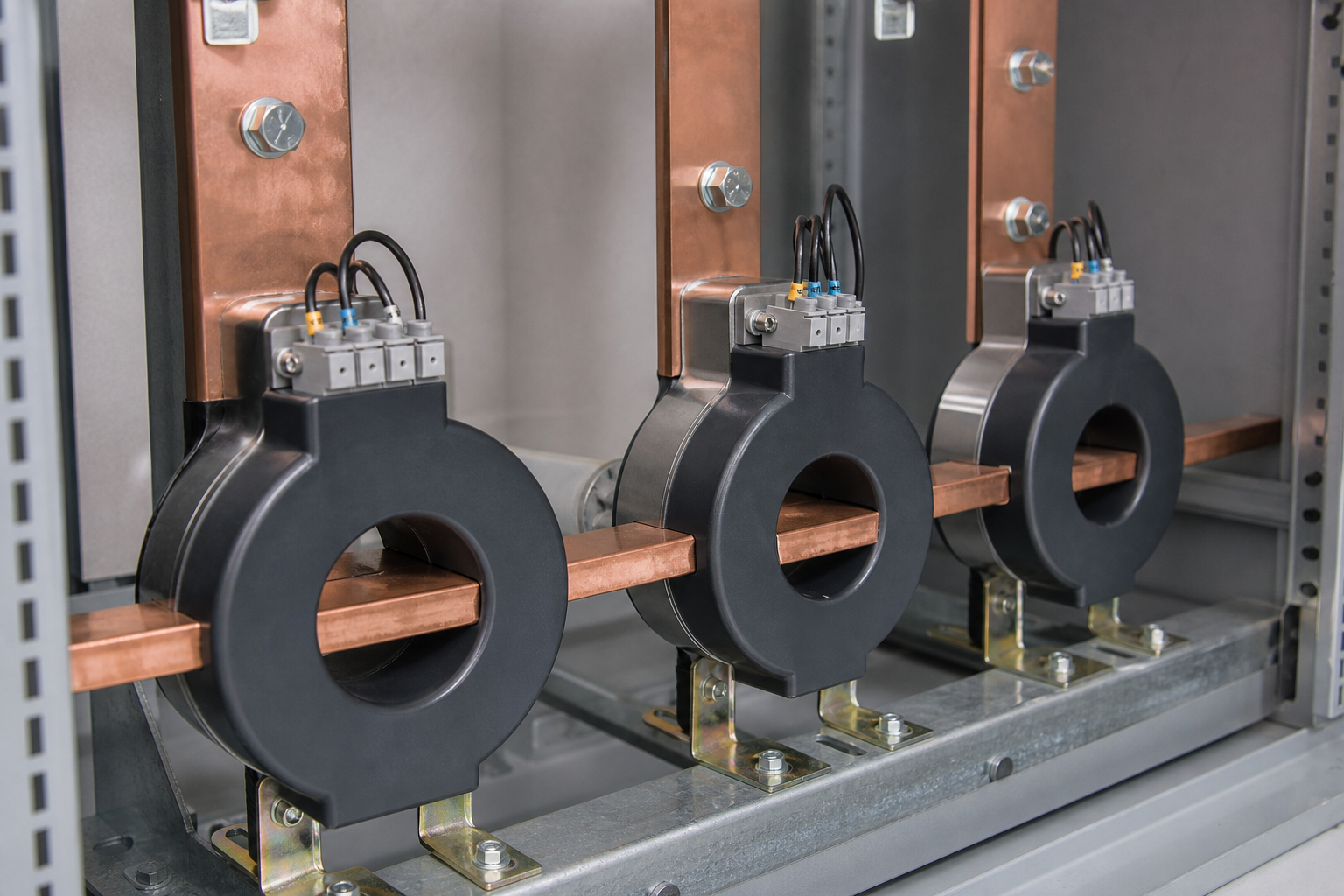
| Ring / window (solid core) | New panels, highest accuracy and best seismic/mechanical stability | Cable or busbar must pass through — cannot be retrofitted without breaking the circuit |
| Split-core (openable) | Retrofit metering into live installations, submetering | Accuracy and phase error slightly wider than solid core; class claims should be certified, not asserted |
| Wound (primary) | Low primary currents where the primary turns are integral | Larger, more expensive |
| Summation / core-balance (CBCT) | Earth-fault detection by summating all phase conductors | Window must fit the cable assembly including sheath arrangement |
Split-core CTs are the classic arena for optimistic datasheets — request the accuracy calibration certificate for the exact ratio ordered, from the manufacturer’s own test bench or a third party.
Screening manufacturers: five checks
- Accuracy certificates per design. Manufacturers should supply ratio error / phase displacement test results (at rated current and burden) for the class claimed. For IEEE-route projects, relaying-class CTs need the standard accuracy voltage rating substantiated.
- Rated burden honesty. A CT specified at 15 VA 5P20 must deliver class performance at that burden. Undersized cores quoted at optimistic VA ratings are a known failure pattern — ask the manufacturer to state the test burden used in verification.
- Short-time and rated continuous current. The CT must carry the panel’s short-time withstand (e.g., 25 kA/1 s) and the normal rated current in the installed thermal environment (inside an enclosure runs hotter than the lab).
- Insulation and the installation class. LV CTs (0.72 kV class) versus MV sensors differ in price and test evidence; medium-voltage current sensing belongs to MV switchgear-grade components with power-frequency and impulse withstand evidence.
- Secondary discipline. Terminal blocks rated for shorting (CTs must never operate open-circuit), marking of polarity (P1/P2, S1/S2), and wiring documentation. Panels arriving with unmarked CT polarity generate commissioning days, not commissioning hours.
Commercial realities
- Lead time: standard ratio LV CTs typically ship in 2–6 weeks from specialist manufacturers; unusual ratios, MV sensors, or large window sizes run longer. For panel builders, CT supply is a recurring bottleneck — second-source qualification for common ratios is standard practice among serious suppliers.
- Price structure: driven by accuracy class, core material (and its market cycle), VA rating, and window size — two CTs at the same ratio can differ several-fold in price legitimately. The illegitimate driver is a missing calibration step; the certificate is your protection.
- Ordering data to lock: ratio, function class, burden (VA), accuracy class, short-time rating, window/busbar size, secondary current (1 A vs 5 A — 1 A reduces lead length losses on long runs), and terminal/shorting arrangement.
A 3,000-piece annual call-off is where CT sourcing discipline pays. At this volume the unit price falls, but so does scrutiny — and a calibration step quietly dropped from the process shows up two years later as meters that disagree across sites with no traceable cause. Structure the framework around evidence instead: a qualified supplier with an audited calibration bench (per-ratio accuracy certificates on file, traceable test burden stated), first-article verification on each ratio family, and lot-level certificates delivered with each release. The budget conversation then becomes about what can safely be standardized — common ratios bundled into fewer variants, secondary current harmonized to one convention across panels — rather than about shaving the calibration that makes every reading defensible.
Questions that predict quality
- Can you provide a sample calibration certificate for the exact ratio and class in my enquiry?
- What burden was used in the accuracy verification, and how does it compare to my panel’s actual secondary load?
- What is the short-time withstand and thermal continuous rating in an enclosed panel at 40 °C ambient?
- How do you handle 1 A vs 5 A secondary selection for my cable run lengths?
- What is the polarity and marking convention, and is it on the drawings I will receive?
FAQ
Why did my CT quote double when I changed class from 0.5 to 0.2?
Tighter ratio and phase error demands better core material and more careful winding — the cost jump is real, not padding. Reserve 0.2s class for revenue metering points where the tariff math justifies it.
Where can cost legitimately be recovered in a CT order?
Rationalize the ratio variants (fewer unique windows and cores), harmonize 1 A versus 5 A secondaries across the panel fleet, and reserve tight-accuracy cores for tariff points only. Standardizing burden to your actual panel load — not a padded legacy VA figure — also trims core size honestly.
How does a 3,000-piece annual call-off change the unit economics?
It shifts value from piece price to the framework terms: first-article calibration verification per ratio family, lot certificates with each release, and second-source qualification for the common ratios. Those terms hold the fleet’s readings consistent across sites and years — the thing a discount cannot repair.
Can one CT serve metering and protection together?
It is technically possible with dual-secondary or multi-core CTs (one core per function), but a single core serving both forces a compromise between accuracy and saturation behavior. Where panel economics allow, separate cores are the standard practice for anything beyond simple indication.
What happens if a CT secondary is left open?
Dangerously high voltage can develop across the open secondary while the primary is energized — CTs must be shorted or connected to their burden before the primary circuit is live. This is a commissioning safety rule, and the reason shorting terminal blocks are part of a well-specified panel.
Related reading
- current transformers — our CT product line for metering and protection duty.
- medium voltage switchgear guide — the switchgear context where most protection CTs operate.
Engineering note: this article is a sourcing framework from ElectricalCabinet.net, a manufacturer of switchgear, control panels, and substation packages with integrated metering and protection current transformers. Final CT grading and protection settings require qualified engineering review against the applicable relay coordination study.
 EN
EN