







The amorphous core transformer exists for one reason: no-load loss. A distribution transformer is energized 8,760 hours a year whether its load is 100% or 3%, and on lightly loaded feeders the core quietly consumes more energy over its life than the load does. Amorphous alloy cores typically cut no-load loss by 60–70% versus conventional CRGO silicon steel — which is why utilities running tens of thousands of distribution units, and facility owners with always-on standby transformers, actively source them. Choosing between amorphous core transformer manufacturers is mostly about verifying that the loss advantage survives the transition from brochure to tested unit, and that the factory can actually process the material.
We build amorphous-core distribution transformers alongside CRGO lines and packaged substations. This guide covers the sourcing questions specific to amorphous technology — the material, the process, and the evidence.
Why the core material changes the sourcing conversation
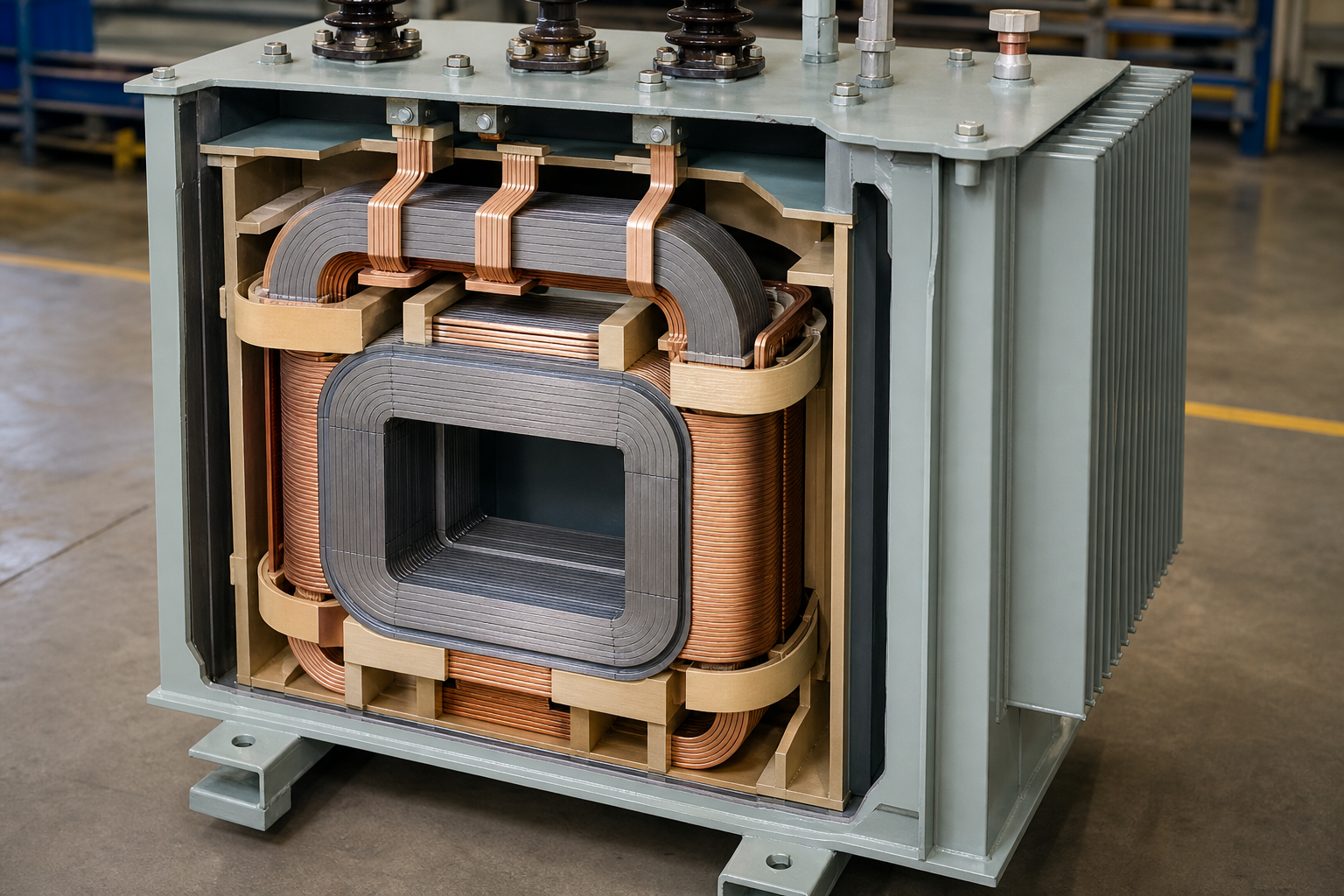
Amorphous alloy ribbons (metglas-type ferromagnetic metglass) are thin — a fraction of the thickness of CRGO sheet — with low coercivity and correspondingly low hysteresis loss. The engineering trade-offs a manufacturer must manage:
| Property | Consequence in production |
|---|---|
| Extreme thinness of ribbon | Cores are wound from thousands of layers; winding tension and edge handling discipline decide performance |
| Brittleness versus CRGO | Cutting, clamping, and transport provisions differ; rough handling degrades performance mechanically |
| Lower saturation flux density | Core cross-sections run larger than CRGO designs — the transformer is physically bigger at the same kVA |
| Annealing sensitivity | Magnetic anneal and cooling curves must be controlled; a poorly annealed core never meets its loss numbers |
The last line is the sourcing point: amorphous performance is process-dependent, so the factory’s annealing and winding capability is what you are actually buying — the alloy itself is a commodity.
The five checks specific to amorphous sourcing
- Guaranteed no-load loss with tolerance, per unit. The commercial core of an amorphous decision is a number — e.g., “no-load loss ≤ X W at X% tolerance, measured at routine test.” Get it in the contract, and get the measured value in the shipped test report. A manufacturer quoting amorphous performance without per-unit measurement is asking you to trust statistics instead of your transformer.
- Comparison quote on CRGO. Ask for both cores quoted at the same kVA/voltage/impedance, with both loss values and both prices. The payback calculation (higher purchase price vs capitalized no-load saving over service life) is buyer-side arithmetic, and a supplier who obstructs the comparison is telling you the premium is soft.
- Sound level data. Amorphous cores carry a reputation for different acoustic behavior; magnetostriction differs from CRGO, and core clamping design influences it. Where the unit sits near occupied space, request the sound level measurement (IEC 60076-10 route) rather than a typical value.
- Mechanical and transport provisions. Cores must be supported for transport without stressing the ribbon stack; ask how units are clamped, whether impact recorders are used, and what post-transport checks appear in the commissioning procedure.
- Short-circuit withstand evidence. The larger, differently-supported amorphous core does not change winding physics — IEC 60076-5 (or IEEE C57.12.00 route) withstand evidence still applies to the design family. Do not let the efficiency conversation crowd out the fault-duty conversation.
Efficiency regulation context
Amorphous units are typically quoted where buyers want headroom above regulatory floors: DOE 2016 (10 CFR 431) minimum efficiency in the US, and Ecodesign (EU) 548/2014 Tier 2 peak-efficiency values in Europe. Some buyers specify amorphous to meet internal sustainability targets or utility efficiency programs that pay incentives for loss performance — ask your utility about loss-reduction programs; where they exist, they change the payback math materially. Confirm which regime your certification documentation covers before ordering, especially for US-bound shipments.
Where amorphous pays — and where it does not
- Pays: rural and residential distribution feeders with low load factor; standby and emergency transformers energized continuously at near-zero load; PV/wind collection transformers idle at night; any tariff structure penalizing standing losses.
- Weak: heavy industrial duty at high continuous load factor, where load loss dominates and the no-load advantage is diluted; space-constrained installations sensitive to the larger footprint; projects where first cost outweighs operating cost by charter.
A good manufacturer tells you which side of this line your project falls on before you ask.
Program scale and market set the payback arithmetic. On a 500-unit IEC-market program — rural or residential feeders, the classic low-load-factor duty — the amorphous premium is decided by two numbers you control in the contract: the guaranteed no-load loss per unit with tolerance, and the capitalized value of that saving at the utility’s or owner’s energy price over the study life. At 500 units, a per-unit no-load saving measured in tens of watts becomes a material line in a program budget, but only if the measurement discipline holds across the whole run — which is why the routine test report per serial number, with the measured loss value, belongs in the framework terms rather than a sampling concession. Where Ecodesign (EU) 548/2014 Tier 2 documentation applies, confirm it covers the amorphous variant specifically, not just the CRGO family baseline.
Lead time and commercial realities
Amorphous ribbon is produced by a small number of global suppliers and allocation cycles are real — lead times for amorphous-core units typically run longer than CRGO equivalents (commonly 10–16 weeks for distribution ratings, longer for utility programs). Manufacturers holding material positions or dual-sourcing ribbon quote firmer dates. Ask directly: what happened to your amorphous deliveries during the last material allocation?
Questions for the shortlist
- What guaranteed no-load loss (with tolerance) applies to my rating, and how is it verified per unit?
- Quote the CRGO alternative at identical electricals so I can run the payback.
- What annealing and winding process controls apply, and what in-process records exist?
- What are the transport and commissioning provisions specific to the amorphous core?
- Which efficiency regime (DOE / Ecodesign / utility program) does the certification cover?
FAQ
Do amorphous transformers cost more?
Purchase price is typically higher than CRGO at the same rating — the material is costlier and the core larger. Total owning cost is frequently lower wherever the unit runs long hours at low load. That is the whole commercial structure of the technology: pay more upfront, buy back the difference in avoided core loss.
How do I run the payback against my own tariff?
Require both cores quoted at identical electricals (kVA, voltages, impedance, losses guaranteed with tolerance), then capitalize the no-load difference at your energy price across the expected service life. The crossover point is your load profile — low load factor favors amorphous strongly, high load factor weakens the case.
How does a 500-unit IEC utility program change the premium math?
The payback multiplies but so does measurement risk: insist on per-unit measured loss in the routine test report, not family sampling, and hold the tolerance across all releases. A one-watt-per-unit drift unnoticed across 500 units quietly erases the program’s business case.
Are amorphous cores less reliable?
No inherent reliability deficit exists — the technology has decades of utility service history — but the failure modes that do occur trace to mechanical handling and annealing quality, which is precisely why process evidence belongs in your supplier evaluation.
Can existing transformers be retrofitted with amorphous cores?
Not practically. Core replacement is a rebuild-level operation; the technology decision belongs at purchase or major refurbishment.
Related reading
- amorphous core transformers — our amorphous-core product line.
- distribution transformers — the conventional-steel baseline the loss math compares against.
Engineering note: this article is a sourcing framework from ElectricalCabinet.net, a manufacturer of distribution transformers (CRGO and amorphous core), packaged substations, and LV/MV switchgear assemblies. Loss values, payback analysis, and compliance decisions require qualified engineering review against the specific installation and tariff conditions.
 EN
EN