







“Dry-type” is the umbrella term for transformers whose windings and cores are insulated by air, gas, or solid insulation — anything except liquid. But under that umbrella sit at least four distinct constructions, each with different moisture behavior, fire performance, cost, and repairability. Specifiers who treat them as interchangeable end up with the wrong construction for the room it must live in. This guide breaks down the dry-type transformer types actually offered by manufacturers, what each is good at, and how to match one to an installation.
The four constructions you will actually be quoted
1. Open wound / VPI (vacuum pressure impregnated)
Windings are wound with fiberglass or polyester insulation, then impregnated with polyester or epoxy resin under vacuum and pressure, and cured. The coil surfaces remain somewhat open — hence “open wound” — inside a ventilated enclosure.
- Typical duty: general industrial LV and MV distribution, 15 kVA to a few MVA.
- Strengths: economical, repairable (rewinding and re-impregnation are established practice), lighter than cast units.
- Watch-outs: moisture behavior is construction-dependent — the relevant classification is the climate class (C1/C2 per IEC 60076-11); condensation-duty installations need C2 and possibly heater provisions. Environments with conductive dust or aggressive chemical atmospheres challenge open surfaces.
2. VPE / multi-dip varnish
A development of VPI using epoxy-based varnishes with multiple dip-and-bake cycles, producing a thicker, more sealed surface. Frequently offered for marine, offshore, and heavy-industry duty where salt fog and humidity are constant. Where your specification mentions marine or tropical service, look for the environment class (E2 per IEC 60076-11, covering condensation and pollution) with test evidence.
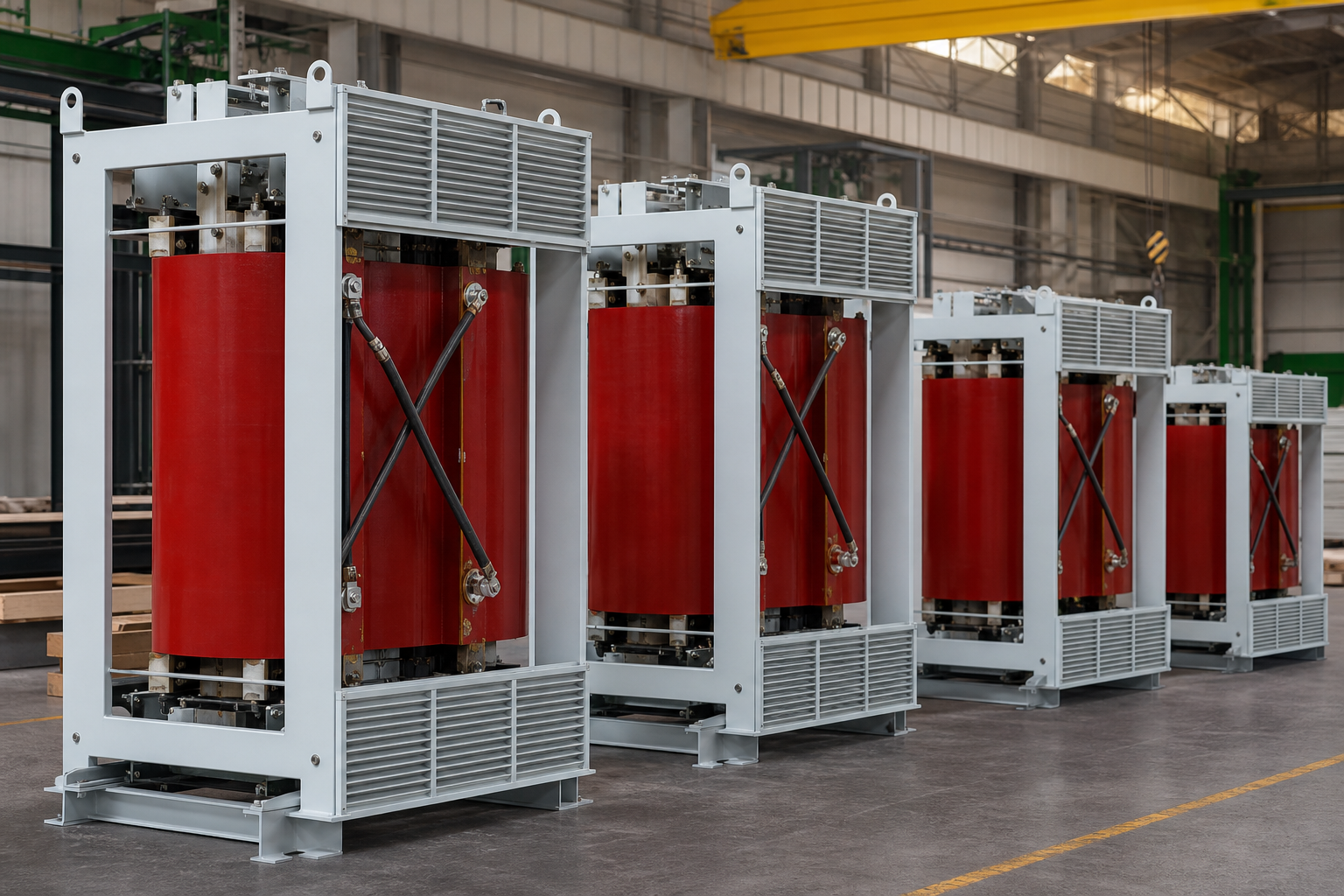
3. Cast resin (vacuum-cast epoxy)
MV windings are placed in molds and cast under vacuum with epoxy resin loaded with quartz filler, usually reinforced with fiberglass mesh. The result is a solid, moisture-immune winding.
- Typical duty: MV distribution indoors — buildings, infrastructure, data centers, tunnels, offshore.
- Strengths: excellent moisture and pollution performance (C2/E2 territory), superior fire behavior where specified as F1 per IEC 60076-11 (self-extinguishing, limited smoke and toxicity), dimensionally stable windings.
- Watch-outs: higher cost; repair means coil replacement rather than rewinding; casting-line process quality is everything — partial discharge values on the routine test report are your window into it.
4. Encapsulated / sealed coil
Smaller units where the coil is fully enclosed in resin (poured or shell-encased rather than precision vacuum-cast). Common in control transformers and specialty LV duty. Robust and neat, at ratings where the cast-resin overhead is unnecessary.
Two cross-cutting variables: insulation class and cooling
Insulation class / temperature rise. Dry-type windings are built with thermal classes — typically Class F (155 °C) and Class H (180 °C) materials. The independent question is the rated temperature rise: a Class F transformer can be specified at 100 K rise (using the class fully) or 80 K rise (derated, longer insulation life, often specified for critical duty). The combination “Class H insulation, 100 K rise or F rise” appears on well-specified datasheets; a quotation silent on rise is quoting you a number you cannot evaluate.
Cooling mode. AN (air natural) is the baseline; AF (air forced, with fans) buys roughly 25–40% additional output on designs so equipped. The cooling classification appears in the designation (e.g., AN/AF on the nameplate per IEC 60076-2 conventions). Fans add a maintenance item and a noise step when running — size the base AN rating for normal load and treat AF as overload headroom, not baseline capacity.
Matching construction to installation
| Your situation | Construction that fits |
|---|---|
| Indoor industrial substation, benign air | VPI open wound, Class F, AN |
| Coastal / outdoor-covered / humid plant | VPE or cast resin, C2/E2 environment class |
| High-rise, tunnel, metro, offshore fire-sensitive | Cast resin with F1 fire behavior evidence |
| Data center / critical continuous duty | Cast resin or premium VPI, 80 K rise, AF headroom, monitored temperature |
| Control circuits, small specialty units | Encapsulated or small VPI |
Constraints collapse the table fast. If the order is 50 units for hot plant rooms on an IEC-market project, two rows survive serious consideration: premium VPI with verified climate class where the rooms are hot but dry, and cast resin with C2/E2 evidence where humidity or washdown adjacency enters. The hot-room variable does the most filtering — at sustained elevated ambient, the temperature-rise specification is what protects rating, so the construction choice matters less than the rise class and cooling margin written into the datasheet. An honest quotation for that duty pairs the construction with a derating statement at your actual ambient; one that quotes reference conditions alone is selling a rating the room will not deliver.
Selection inputs to record before requesting quotations
- Rated power and voltages, phases, frequency, vector group, impedance.
- Indoor/outdoor, ambient temperature profile, altitude (derating above 2,000 m), corrosion environment.
- Fire requirements of the room (F1 evidence needed or not), noise limits, space and access constraints.
- Harmonic content of the load (k-factor or derating need — see our harmonic/k-rated guidance).
- Overload expectations — define AF headroom explicitly rather than hoping.
- Standards regime: IEC 60076-11 (with C/E/F classes) or IEEE C57.12.01; DOE 2016 / EU Ecodesign efficiency documentation where applicable.
FAQ
Is cast resin always better than VPI?
No — it is better for moisture, pollution, and fire-sensitive duty, at higher cost and with coil-replacement repair economics. Benign indoor industrial duty is served economically by VPI; specifying cast resin everywhere buys performance you will never use.
Which site conditions actually force the upgrade?
Sustained humidity or condensation cycles (C2/E2 territory), corrosive or conductive atmospheres, washdown adjacency, and fire strategies demanding F1 behavior. Absent those, a well-processed VPI winding serves hot-but-benign rooms for its full design life.
For 50 units in hot plant rooms on an IEC project, which combination is the economic answer?
Premium VPI, Class F insulation specified at 80 K rise (the margin that survives a hot room), C2 climate class where humidity appears, and IEC 60076-11 documentation per unit. Cast resin earns its premium in that program only where the fire or moisture rows genuinely apply — not as a default upgrade.
What does F1 actually certify?
Fire behavior class per IEC 60076-11 — self-extinguishing behavior with defined limits on smoke and toxic emissions, verified by test. F0 is the default (no special fire performance). Building authorities and tunnel/offshore specifications increasingly demand F1 with a test report.
Why is my dry-type transformer bigger than the oil unit it replaced?
Air is a worse coolant than oil and solid insulation a worse heat path than oil-impregnated paper — so dry-type designs run physically larger and more conservatively loaded at the same kVA. Plan rooms accordingly: clearances, ventilation, and door swing are real project variables.
Do dry-type transformers need maintenance?
Much less than oil units — no oil sampling regime — but not zero: clean the windings and enclosure ventilation on a schedule suited to the air quality, verify connections and fan operation, and for MV units consider partial-discharge trend checks where the criticality justifies instrumentation.
Related reading
- dry-type transformers — the product family these construction types belong to.
- transformer kVA calculator — rating selection once the construction type is chosen.
Engineering note: this article is a construction and selection overview from ElectricalCabinet.net, a manufacturer of dry-type (VPI and cast resin) and oil-immersed distribution transformers plus packaged substations and switchgear assemblies. Final construction selection and ratings require qualified engineering review against the applicable installation codes.
 EN
EN