







Agricultural irrigation control panels coordinate pumps, valves, sensors, schedules, alarms, and remote monitoring for a defined irrigation system. The correct arrangement depends on the water source, pump and valve equipment, field layout, operating sequence, environmental conditions, and the responsibilities of the irrigation and electrical teams. This guide collects the planning inputs that turn “an irrigation panel” into an engineerable scope — and marks the boundaries no generic article can cross.
This article is an application-planning guide. It does not claim a specific farm project, irrigation controller model, communication service, or certified outdoor installation for any product shown on this website.
Define the irrigation system boundary
Before choosing a panel, describe the part of the irrigation system the control cabinet will operate. A project may include a water source, pumps, filtration, valves, tanks, sensors, weather inputs, fertigation equipment, remote monitoring, or a higher-level farm management system.
Record:
- the water source, storage, pumps, and distribution zones;
- valves, actuators, filters, dosing equipment, and field devices;
- normal, scheduled, manual, standby, and fault operating modes;
- pressure, flow, level, soil, weather, or other process feedback; and
- local, remote, cellular, radio, or plant-system interfaces required by the project.
The phrase “irrigation control panel” does not define the required I/O, communications, enclosure, or control logic. Two installations using the same words can differ by an order of magnitude in complexity — a two-pump field booster panel and a fertigation-integrated zone controller are different engineering products.
Common irrigation control functions
Pump and water-source control
The panel may coordinate pump starting, stopping, alternation, permissives, alarms, or variable-speed operation. Define pump and motor data, pressure or flow objectives, dry-run protection responsibility, and the expected response to loss of feedback. On variable-speed systems, agree whether pressure or flow is the controlled variable and what the drive does when its feedback disappears.

Zone and valve control
Irrigation zones may require scheduled valve operation, sequencing, feedback, and fault indication. The zone list should identify each valve, actuator, cable route, power source, and field responsibility. Long field cable runs deserve attention: conductor sizing for valve solenoids, loop resistance, and surge exposure on buried runs all belong in the panel specification, not in a later discovery.
Filtration and treatment interfaces
Filters, dosing systems, and treatment equipment can introduce additional status, alarm, and interlock signals. The panel scope should state which equipment is controlled, which signals are provided by others, and who owns the process sequence.
Remote monitoring and scheduling
Remote operation may involve a local controller, HMI, farm-management platform, cellular connection, radio link, or another approved interface. Define the required data, alarm ownership, access responsibilities, and behavior when communication is unavailable. Do not infer a particular wireless or cloud capability from a generic image.
Environmental and enclosure inputs
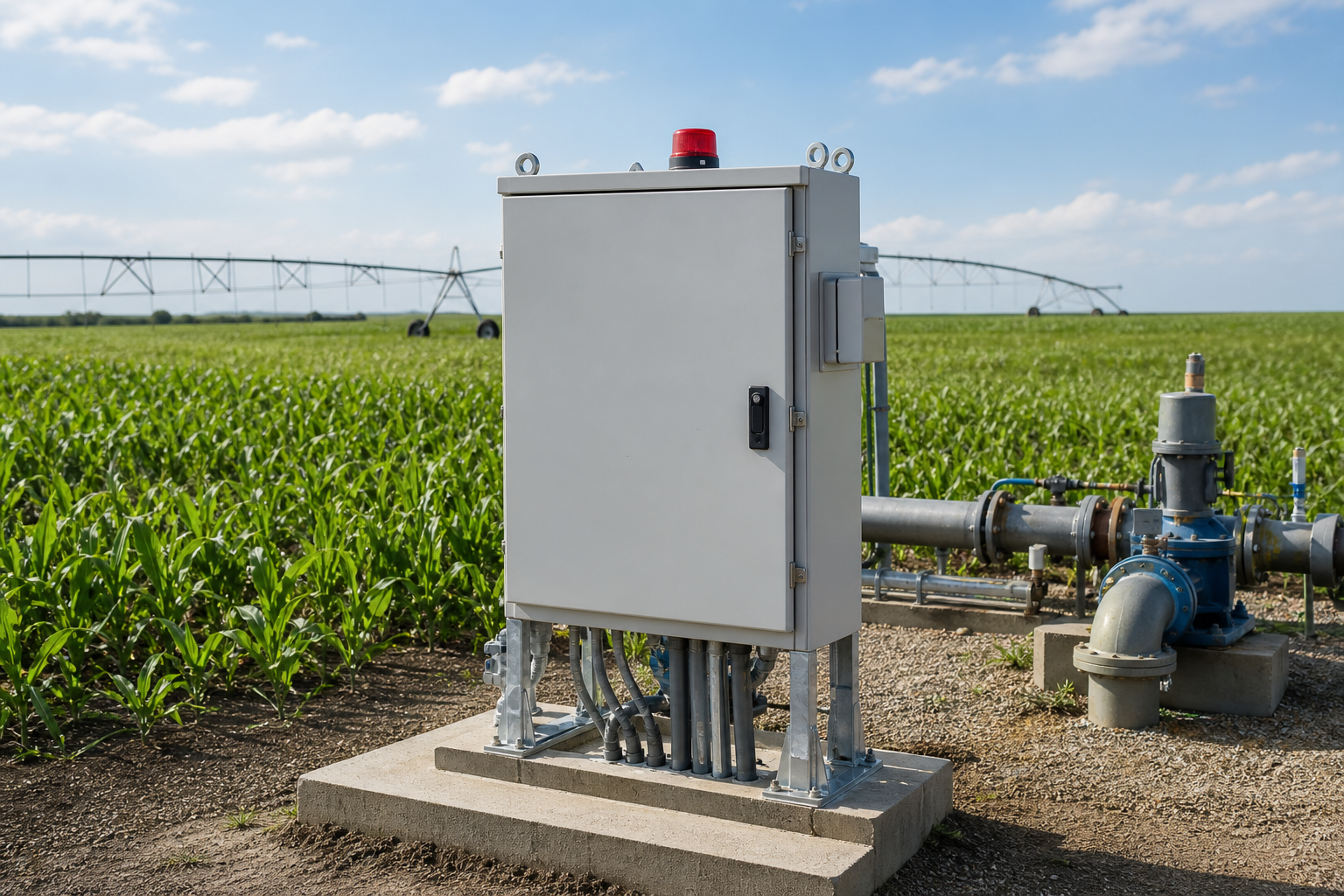
Agricultural installations can face rain, dust, soil, fertilizer, chemicals, sunlight, temperature changes, condensation, insects, vibration, and difficult maintenance access. Review mounting, cable entry, drainage, corrosion strategy, heat, door access, labels, and service clearances together.
If a NEMA or IP classification is required, confirm it for the exact model and configuration. The material, color, or appearance of a cabinet does not prove an environmental rating. Outdoor agricultural cabinets commonly target rain-and-dust protection classes — the NEMA 3R enclosure family covers rain-exposed mounting, while washdown or fertilizer-exposed locations usually move the choice toward the NEMA 4X enclosure family; the NEMA-to-IP converter translates between the two rating languages once the specification names one.
Standards context for irrigation panels
- UL 508A — the industrial control panel standard applied when irrigation panels ship into the NEC market; it governs construction, component selection, and the marked short-circuit current rating of the assembled panel.
- NFPA 79 — the electrical standard for industrial machinery in the NEC market, relevant where the irrigation system is treated as powered machinery with defined disconnecting and control-circuit requirements.
- IEC 61439 — the assembly framework for panels delivered into IEC-market projects, defining the ratings and verification documents the panel carries.
- NEMA 250 / IEC 60529 — the enclosure protection standards behind the type numbers and IP codes quoted for outdoor agricultural cabinets.
Agricultural power installations may also fall under local rural-supply codes and utility interconnection rules; those requirements are determined by the project’s electrical engineer, not by the panel builder.
Information needed before quotation
| Input area | Questions to define |
|---|---|
| Water system | What source, pumps, storage, pressure, flow, and zones are included? |
| Field devices | Which valves, sensors, meters, filters, and dosing devices connect? |
| Control sequence | Which schedules, priorities, alternation, permissives, and alarms apply? |
| Interfaces | What local, remote, monitoring, and maintenance interfaces are required? |
| Environment | What outdoor exposure, chemicals, temperature, mounting, and access apply? |
| Documentation | Which drawings, I/O lists, labels, manuals, and test records are required? |
| Responsibilities | Who supplies process data, installs field wiring, programs, and commissions? |
This information helps distinguish a pump control panel from a broader irrigation automation system.
Application planning checklist
Before approving a control-panel scope, confirm:
- the pump, valve, sensor, and zone list;
- the operating sequence and manual/automatic modes;
- alarm, permissive, interlock, and loss-of-communication behavior;
- local and remote control responsibilities;
- enclosure and field installation conditions;
- cable, terminal, labeling, and documentation requirements; and
- assumptions, exclusions, and commissioning boundaries.
For pump-specific planning, see the pump control panel design guide. For broader PLC architecture, see the PLC control cabinet page.
Frequently asked questions
Can one panel run both the pumps and the irrigation zones?
Yes, and on small systems it is usually the economical answer. On larger pivots or multi-field systems, a pump-house panel plus zone controllers in the field keeps cable runs short and isolates faults — the split follows the field layout, not a rule of thumb.
Follow-up: how far can valve solenoids be from the panel?
It depends on conductor size and solenoid current: the loop resistance of the buried run decides whether the valve actually receives its operating voltage. The panel specification should include the cable schedule so voltage drop is checked at design time, not discovered at commissioning when the farthest zone fails to open.
What protection does a buried field cable need?
Surge exposure is the main concern on long outdoor runs, together with normal overcurrent protection per the applicable electrical code. Surge protective devices at the panel boundary, and grounded cable shielding where specified, reduce the lightning damage these runs collect every storm season.
Does the panel need to work when remote communication is down?
If irrigation must continue, yes — define a local fallback schedule or manual mode and document who is authorized to use it. If loss of communication should stop irrigation, define that state explicitly. Either behavior is acceptable; an undefined one is not.
Who programs the irrigation schedule?
The schedule logic is process scope, typically owned by the irrigation designer or grower; the panel builder delivers the hardware and the agreed control logic. Confirming this split at quotation prevents a panel arriving with no way to enter the watering plan.
Image and case-study boundary
Agricultural or irrigation images can illustrate an application context, but they do not prove that a particular customer project was delivered, that a controller supports a specific field size, or that a cabinet has a particular rating. Use captions such as “illustrative irrigation application” unless project evidence is available.
Final review
An agricultural irrigation control panel should be specified from the water system, field devices, control sequence, environment, interfaces, and documentation requirements together. A clear boundary between the control cabinet, irrigation equipment, field installation, and remote platform prevents assumptions from becoming undocumented project requirements.
Ordering scenarios
A grower or irrigation contractor upgrading a pump station usually orders a single panel first — the pump-house unit — proves it through a season against the well and zone equipment, then orders the satellite zone panels once the interface behavior is confirmed. The binding constraints are the seasonal window and the field-device delivery schedule, because a panel that arrives after the planting window waits unused until next season.
An irrigation-equipment distributor serving both NEC-market and IEC-market territories should fix the panel regime per destination early: the North American unit is built and documented to UL 508A with NFPA 79-aligned machine documentation, while the IEC-market unit carries IEC 61439 verification documents and IP-coded enclosures. Confirming the split on the pilot order — typically one panel per market — avoids rebuilding the documentation package when the seasonal series order arrives.
 EN
EN