







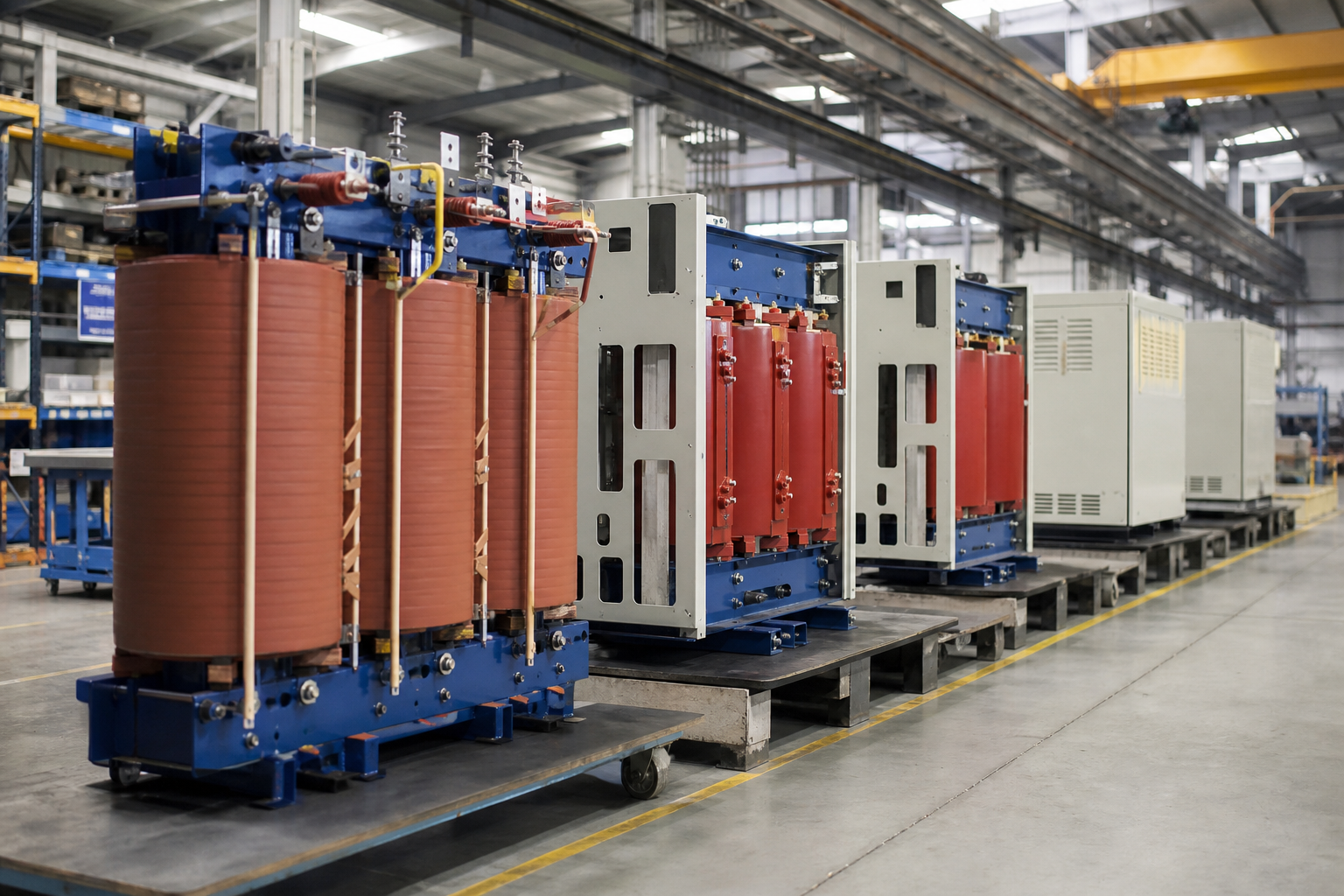
Dry-type transformers are chosen precisely where failure is least acceptable: inside buildings, next to the load, in hospitals, data halls, tunnels, and marine and offshore installations where oil is not welcome. Because there is no liquid to mask marginal workmanship, the entire quality of a dry-type unit lives in its winding insulation processing and its enclosure — and the difference between dry-type transformer manufacturers is the difference between a vacuum-cast coil that survives thirty years of thermal cycling and one that develops partial discharge in year three.
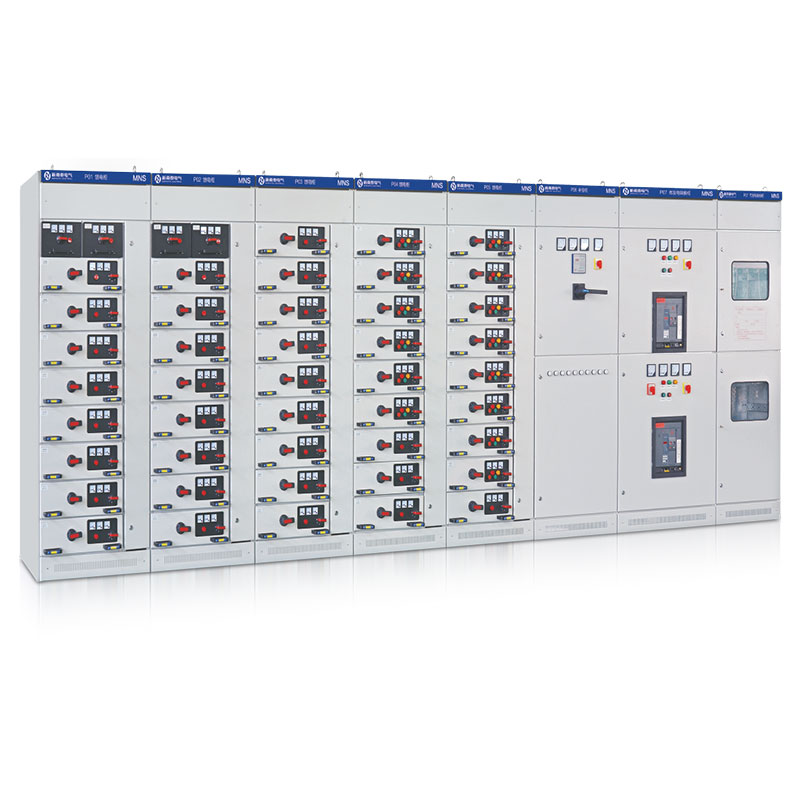
We build dry-type transformers alongside the LV/MV switchgear and control assemblies they feed, and most of our dry-type enquiries end up packaged into complete distribution solutions. This is the framework we recommend buyers use to screen any dry-type supplier, including us.
Which dry-type construction are you actually buying?
“Dry-type” covers several distinct builds, and a manufacturer’s capability is rarely uniform across them. Confirm which one your enquiry needs before comparing suppliers:
| Construction | Insulation system | Typical application | Key verification |
|---|---|---|---|
| VPI (vacuum pressure impregnated), open wound | Polyester/epoxy resin, Class F or H (155/180 °C) | General industrial, LV/MV units | Process records for every impregnation cycle |
| VPE / multiple dip-and-bake | Epoxy-enhanced varnish, deeper seal | Harsh or humid environments, marine | Salt-fog and moisture test evidence |
| Cast resin (vacuum-cast epoxy) | Epoxy + silica filler, glass-mesh reinforcement | MV distribution, high fire-risk sites | IEC 60076-11 climate C2/E2, fire behavior F1 evidence |
| Encapsulated / sealed coil | Resin-encased, smaller units | Control and specialty duty | UL 5085 or equivalent compliance path |
A supplier who describes all of these as “the same thing, just epoxy” is telling you where their engineering depth ends. The standards reference point for dry-type requirements is IEC 60076-11 (and IEEE C57.12.01 for the North American route) — a credible manufacturer quotes these unprompted.
The four-stage production capability that decides coil life
- Winding. Tension-controlled foil or strip windings for LV, disc or layer windings for MV, with correct transposition on parallel conductors. Poor tension control shows up later as changing winding resistance and hot spots under load cycling.
- Insulation processing. This is the heart of dry-type quality. VPI cycles must be executed under documented vacuum and pressure with measured resin viscosity; cast-resin coils must be poured on a vacuum casting line with recorded mix ratios and cure profiles. Ask to see a process record from a recent batch — plants with nothing to hide produce these routinely.
- Enclosure and cooling. Ventilated enclosures (AN cooling, AF with forced-air for upgraded output) must be dimensioned for the temperature rise and IP rating quoted. Check enclosure material thickness, finish for the environment (indoor, outdoor, C4/C5 corrosion class near coast or industry), and whether fans and controls are from named brands.
- Routine testing on every unit. Ratio and vector group, winding resistance, no-load and load loss, impedance, induced and separate-source withstand tests, and — critically for MV dry-type — partial discharge measurement. A dry-type manufacturer who does not perform PD testing on every MV coil is flying blind on the exact failure mode that matters.
Certificates to request, with numbers
- IEC route: IEC 60076-11 conformity, including climate class (C1/C2), environment class (E0–E2), and fire behavior class (F0/F1). F1 with self-extinguishing behavior is the specifier requirement for buildings, tunnels, and offshore — verify it with a test report, not a brochure claim.
- North American route: IEEE C57.12.01 design basis, UL 1561 (dry-type general purpose) or UL 5085 listing where the installation demands it, and DOE 2016 efficiency compliance (10 CFR 431) for covered ratings.
- EU route: CE under LVD, and Ecodesign (EU) 548/2014 Tier 2 efficiency values for distribution ratings.
- Sound level: IEC 60076-10 measurement records when the unit sits in an occupied space — dry-type units near offices are one of the most common noise complaints in the industry.
The honest comparison table: what drives price differences
| Factor | Low-quote unit | Properly built unit |
|---|---|---|
| Insulation class | Class F “equivalent” without cycle records | Class F/H with documented VPI or casting process |
| Temperature rise | 100 K+ at rated load, quietly | 80 K (Class F insulation) or as specified, tested |
| Core material | Standard CRGO, unknown grade | Named CRGO grade or amorphous where loss matters |
| PD testing | “On request” | Every MV coil, with values in the routine test report |
| Enclosure | Minimum steel, thin finish | Environment-rated, correctly dimensioned for AF cooling |
| Loss values | Quoted without tolerance | Guaranteed values with tolerance, measured per unit |
Environment and volume decide what “verified” must mean. For 500 units destined for hot plant rooms — electrical rooms running elevated ambient around the clock — the comparison table’s temperature-rise row becomes the whole game: an enclosure rated at reference ambient spends its life derated in that service, and the honest quotation states the rise at your actual conditions with the cooling margin to match. At this order size the type-test evidence also scales: accredited-lab reports (KEMA-CESI, ASTA, CPRI, or CNAS-accredited labs) for the cast-resin or VPI family, partial-discharge values on every MV coil, and climate class C2 with test backing where the rooms are humid. A supplier whose “F1” and “C2” markings arrive without report numbers at a 500-unit award is asking you to underwrite three decades of thermal risk on a brochure.
Lead time and capacity reality
Standard LV dry-type ratings typically ship in 4–8 weeks from a production-ready design; MV cast-resin and specialty engineered units (drive isolation, k-rated, high kVA) commonly run 8–14 weeks because casting line time and engineering review gate the schedule. Mid-size plants deliver tens to a few hundred units per month across dry-type lines. As always, the number that matters is whether your delivery window is protected in the production plan and backed by a written schedule.
Questions that predict reliability
- What is the routine test list executed on every unit, and can I have a sample report with my enquiry?
- What PD level do you guarantee on MV cast-resin coils, and at what test voltage?
- What insulation class and temperature rise combination does this quotation assume — and where does it appear on the datasheet?
- How does the enclosure handle the site environment (corrosion class, IP, altitude above 2,000 m)?
- What is the repair path for a damaged MV winding — rewind in plant, replacement coil exchange, or scrap?
FAQ
Are dry-type transformers less reliable than oil?
Not intrinsically — but dry-type quality is more sensitive to insulation processing discipline, because there is no oil providing additional dielectric margin and heat transfer. That is exactly why manufacturer selection matters more for dry-type, not less.
Does “cast resin” always mean better?
Cast resin brings superior moisture and fire performance for MV indoor duty; VPI open-wound remains the economic standard for many LV industrial duties. The right question is which construction your environment and standard regime require, not which is universally “better.”
What is F1 fire class and when do I need it?
F1 per IEC 60076-11 designates self-extinguishing behavior with limited toxic emissions — typically specified for installations inside buildings, tunnels, and offshore platforms where fire load must be minimized. Verify with a test report; it is frequently claimed without evidence.
What do F1 plus C2/E2 add to price and lead time?
F1 pushes the specification toward cast resin with its filler and glass-mesh system; C2/E2 add climate and environment verification to the qualification. Together they typically move a unit up a cost tier and add test-evidence lead time — which is exactly why the claim must carry a report number.
How does the spec change for 500 units going into hot plant rooms?
Fix temperature rise at your real ambient, not the reference condition; pair it with C2 where rooms see humidity, and F1 only where the fire strategy demands it. Then verify per-unit routine records at those values — at 500 units, a modest rise overrun is a fleet-wide derating you discover in summer.
Related reading
- dry-type transformers — our dry-type product line and constructions.
- enclosure condensation and ventilation — the installation-environment factors that follow the build.
- kVA calculator — rating selection before construction verification.
Engineering note: this article is a procurement evaluation framework from ElectricalCabinet.net, a manufacturer of dry-type and oil-immersed distribution transformers, packaged substations, and LV/MV switchgear and control assemblies. Final ratings, protection settings, and compliance decisions require qualified engineering review against the applicable installation codes.
 EN