







Before a custom automation project is specified, quoted, or approved, the honest question is not “which solution” but “is this process ready to be automated at all.” Readiness is measurable: process stability, data quality, interface clarity, maintenance staffing, documentation discipline, change control, and organizational goals each either de-risk or silently doom the project. This guide provides an eight-dimension readiness assessment you can score before spending engineering money, explains what each dimension means in practice, and shows how the answers shape scope — so custom automation benefits are claimed on evidence rather than enthusiasm. It supports design and procurement discussions; final installation, code, safety, testing, cybersecurity, and qualified engineering requirements must be confirmed for the actual project.
The readiness assessment, dimension by dimension
| Dimension | Ready (green) | Not ready (red) |
|---|---|---|
| Process stability | Steps, timings, and quality parameters repeat within known tolerance | The process itself is adjusted by operator judgment run to run |
| Process data | Yields, cycle times, and failure modes recorded for months | No baseline — automation would change the process before it was ever measured |
| Interface clarity | Machines, utilities, and IT interfaces drawn and owned | “The integrator will figure out the interfaces” appears in planning notes |
| Maintenance capability | Technicians trained for controls and instruments, or training budgeted | First PLC fault becomes an external service call with days of downtime |
| Documentation discipline | Existing drawings and procedures current | Current state of the manual process itself undocumented |
| Change control | Product and process changes flow through a managed process | Frequent informal changes that no software revision can track |
| Demand profile | Volumes and mix justify capital and changeover design | Automation pursued for image, with volumes that never repay it |
| Organizational goal | Named, measurable objective (throughput, quality, safety, labor allocation) | “More automation” as the objective |
Score honestly: any red on process stability or change control should stop the project at the concept stage, because automating an unstable process produces faster instability.
Define the system boundary
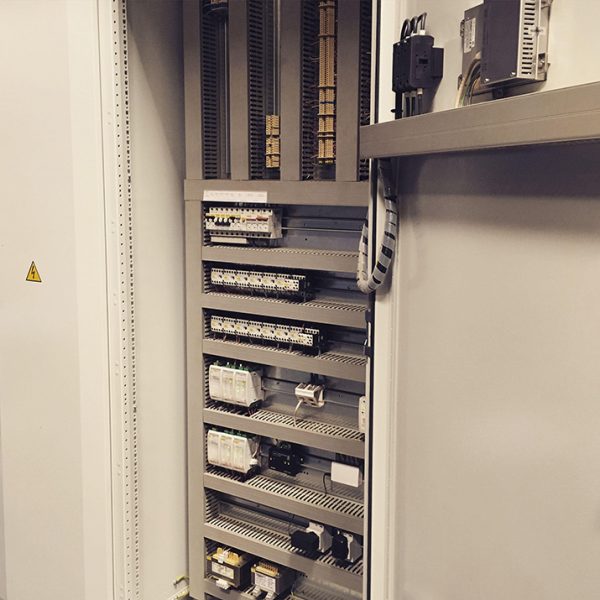
Separate the control cabinet, field devices, PLC, HMI or supervisory software, networks, site conditions, and responsible engineering disciplines before selecting a configuration. Readiness work sharpens this boundary: it is where you discover that the data you planned to collect is not currently measured, or that the maintenance team the project assumes does not yet exist.
Inputs to document
| Input | Why it matters |
|---|---|
| Equipment and interfaces | Sets layout, entries, clearances, signals, power, network paths, and service access. |
| Process and environment | Guides sensor choice, material, heat, corrosion, moisture, and exposure review. |
| Installation and maintenance | Controls mounting, isolation, access, labels, replacement, and service sequence. |
| Validation and records | Defines drawings, testing, alarm checks, software handover, and supplier documentation. |
Do not transfer a competitor automation performance, cybersecurity, safety, or compliance claim to the complete project without project-specific evidence.
What benefits to claim, and how
Custom automation benefits concentrate in five areas: throughput from cycle consistency, quality from measurement and interlocks rather than operator vigilance, safety from removing people from hazard zones, traceability from logged process data, and labor reallocation from repetitive handling to supervision and maintenance. Each claim should be grounded in the baseline you measured during readiness — a throughput claim without a measured current cycle time is a hope, not a benefit. Costs to include beyond equipment: engineering and software, site works and downtime windows, training, spares for the new failure modes you are adding, and the recurring cost of maintaining competence in the technology you have chosen.
The failure modes readiness screening prevents
Projects fail in patterns. Automation of an undocumented process discovers the real process six weeks into commissioning. Unstaffed maintenance converts minor sensor faults into shift-long outages. Undefined interfaces between machine vendors and controls vendors produce a working cabinet connected to nothing. Missing change control makes the first product revision obsolete the code. Each of these is visible in the readiness table above — which is the entire argument for scoring before specifying.
Frameworks and standards that structure the follow-on project
Once readiness is green, the standards landscape for the build itself: panel compliance per market (UL 508A with NFPA 79 in North America, IEC 61439-1/-2 and IEC 60204-1 in IEC markets), safety functions under IEC 61508 or ISO 13849 with levels set by machine risk assessment, and cybersecurity per the IEC 62443 series wherever remote access or enterprise connectivity exists. Project management benefits from staged acceptance gates — design freeze, factory acceptance with simulation coverage stated, site acceptance including recovery scenarios — which map naturally onto the evidence rows of the inputs table. Readiness work also feeds the functional specification: the process data you gathered becomes the acceptance criteria the integrator must meet.
Frequently asked questions
How long should readiness assessment take?
Weeks, not months, for a single process: gather the baseline data, walk the process with operators, score the eight dimensions, and decide. The exception is process stability — that needs history, so start logging before you need it.
Can we automate partially and defer the rest?
Yes, and staged scope is usually right: automate the bottleneck or the quality-critical step first, measure, then extend. The staging decision belongs in the boundary definition so the deferred scope does not silently become the integrator’s problem.
Who should run the readiness assessment?
Someone who will live with the result: your process engineer plus the future maintenance lead, with the automation supplier brought in for the interface dimensions rather than the scoring itself — suppliers evaluating readiness grade their own homework.
What if the honest score is mostly yellow?
Proceed with a bounded pilot and explicit closure tasks for each yellow dimension — pilot projects are precisely the instrument for converting yellow to green before full commitment. The follow-up question to answer first: which yellow turns red under production pressure, because that one sets the pilot’s scope.
Does readiness matter for small automation projects?
It scales down but does not disappear — even a single machine cell assumes process stability and a maintenance plan. The assessment for small projects is a one-page version of the same table.
Procurement scenarios
For a plant whose first readiness review fails on stability and data, the correct first purchase is instrumentation and logging — sensors, a small data cabinet, and reporting — for one production line and one quarter, ordered as phase zero with the automation supplier you intend to use later, so the instrumentation architecture already fits the target system. For an organization that is ready and multi-site, contract a framework with one integrator covering a pilot line plus framework pricing for repeats, and gate the repeats on each site passing the same readiness score. For export-market OEMs packaging machines with automation, fix the training and documentation deliverables in the first order — a train-the-trainer session and language-appropriate maintenance manuals cost little at order time and decide whether the second machine sells itself.
ElectricalCabinet.net scopes custom automation from readiness review through delivered panels — pair this assessment with our custom automation solutions overview and the programmable versus fixed automation comparison to frame the scope conversation.
 EN
EN