








This guide is a planning aid. Confirm the final enclosure, material, rating, installation, and compliance requirements against project data, approved drawings, and supplier evidence. Competitor content is topic evidence, not proof of ElectricalCabinet.net capability.
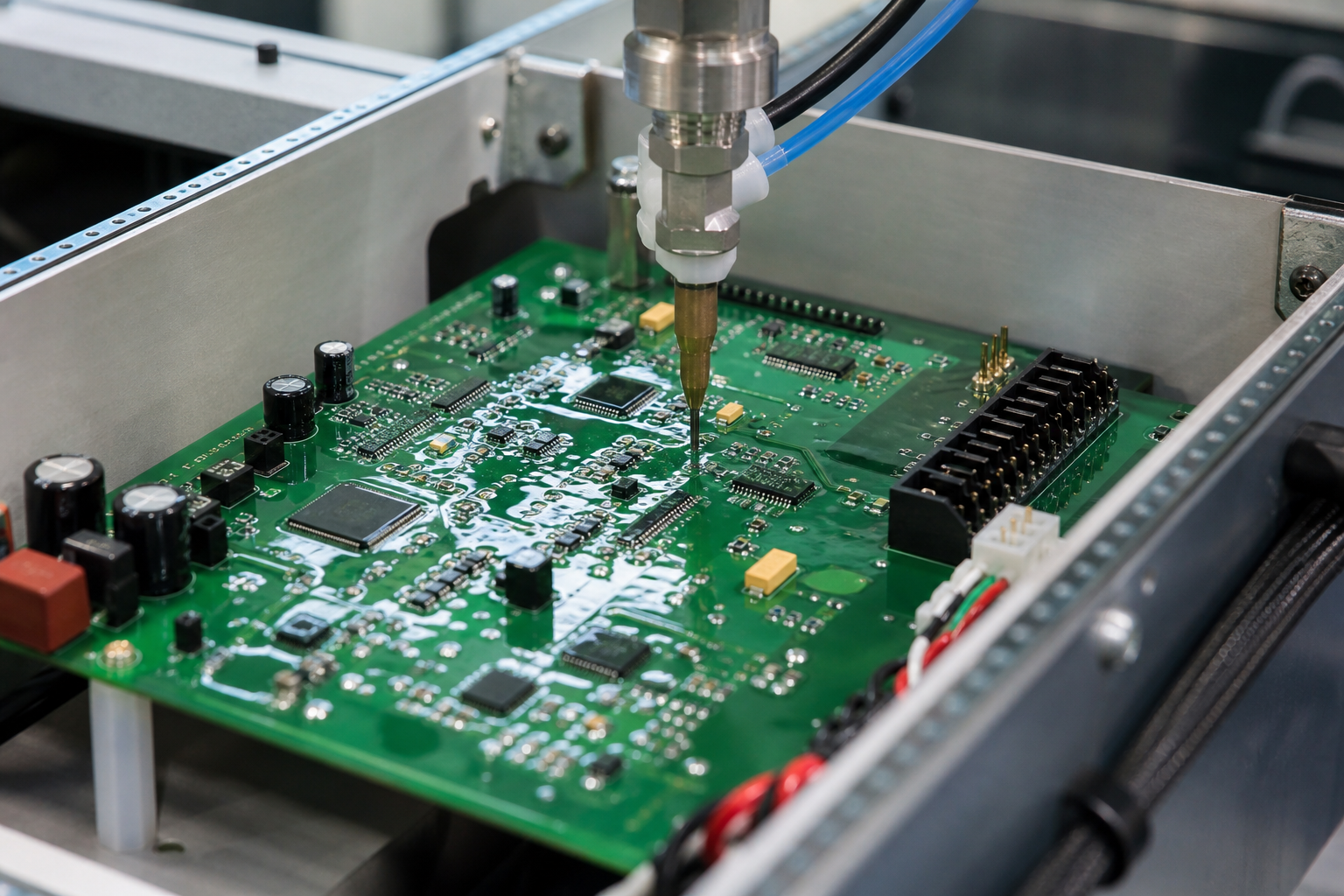
Conformal coating and a waterproof enclosure protect different parts of a system against different failure paths, and neither substitutes for the other. A conformal coating is a thin polymer film – typically 25 to 130 µm – applied directly over a printed circuit assembly, sealing traces, solder joints, and component bodies against moisture, dust, and contamination. An enclosure protects the larger equipment and its interfaces: connectors, terminals, batteries, cables, and the mechanical mounting of everything inside. A coated board in an unsuitable box still fails at its connectors; a sealed box around an uncoated board still fails when trapped condensation forms on it. Robust products frequently use both, specified as one moisture-protection system.
What each layer actually protects
| Aspect | Conformal coating | Waterproof enclosure |
|---|---|---|
| Protected object | The circuit assembly: traces, solder, component bodies | Everything inside: board, connectors, wiring, power entry |
| Typical threat coverage | Condensation films, atmospheric contamination, fingerprint corrosion, dust | Rain, spray, hosedown, immersion, impact, and physical contact |
| Weak points | Connector contacts, terminals, switches, batteries – masked or uncoated by design | Cable entries, gaskets, door openings, vents – every opening and seam |
| Thermal effect | Minor added thermal resistance on coated packages | Sealing traps heat; box material and size set dissipation |
| Service effect | Rework and repair require coating removal and re-application | Designed access – covers, doors, labeled terminals |
The weak-point rows explain why the two protections overlap imperfectly. Coating is deliberately absent where electrical contact must happen – connector pins, test points, relay contacts – and those are precisely the surfaces that corrode in damp air. Enclosure sealing, meanwhile, is defeated by its own service cycle: every door opening in humid conditions admits moisture that then stays inside.
Common coating materials
| Material class | Typical character |
|---|---|
| Acrylic (AR) | Easy to apply and rework, good dielectric properties, moderate chemical resistance |
| Silicone (SR) | Flexible, wide temperature range, good humidity barrier, harder to rework |
| Polyurethane (UR) | Tough, good chemical and abrasion resistance |
| Epoxy (ER) | Hard, chemically resistant, difficult to rework |
| Parylene (XY) | Vapor-deposited, truly conformal coverage, premium performance and cost |
Material selection belongs to the electronics designer – what the enclosure buyer needs from the coating file is what is masked, what thickness and inspection standard apply, and how rework will be done in service.
Questions before combining protections
| Question | Why it matters |
|---|---|
| Where can water enter? | Coating may not protect connectors, terminals, batteries, or cable interfaces – the enclosure and its glands carry those duties. |
| Will the board be serviced? | Coating affects rework, inspection, and repair practices – and sealed enclosures make board access slower, compounding service cost. |
| What is the thermal path? | Coating and sealing can change heat removal and condensation behavior – sealed boxes accumulate heat, then cool and condense. |
| What chemicals are present? | Compatibility must be checked for coating, gasket, enclosure, and hardware – washdown chemicals and industrial solvents attack both layers differently. |
| What is the humidity cycle? | Daily breathing of a non-sealed box challenges coating; full sealing challenges the coating only via internal condensation events. |
Define the system boundary and request evidence for each layer. Do not claim that a coated board makes an enclosure waterproof.
Standards and evidence
- IPC-CC-830. The qualification and performance standard for conformal coatings (successor lineage to MIL-I-46058 qualification practice) – the document behind coating material claims.
- IPC-A-610. Workmanship acceptance criteria, including coating coverage, and the practical inspection reference (coating under components, masking quality).
- IEC 60529. The enclosure-side water protection evidence, attaching to the complete configuration including glands and vents.
- NEMA 250 / UL 50E. North American enclosure types where the housing carries the environmental duty.
- IEC 60068-2 environmental testing. The damp-heat and cycling test methods used to qualify coated assemblies and enclosures alike – the common language for both layers’ evidence.
Frequently asked questions
If the board is conformal coated, can I use a cheaper enclosure?
Sometimes, for clean indoor duty where the only threat is humidity film. The moment connectors, cable entries, or physical abuse matter, the enclosure carries them – coating protects the board, not the interfaces.
Does an IP67 enclosure make coating unnecessary?
No. Sealed boxes breathe during temperature cycles if any gasket or cable path is imperfect, and every service opening admits humid air. Coating is the defense for the board when that moisture condenses overnight.
What fails on a coated board in a sealed box?
Typically the uncoated contact points: connector pins, relay contacts, battery terminals. Trapped condensation finds exactly the surfaces the coating had to leave bare.
How does coating affect repair?
Acrylics rework easily; epoxies and parylene make rework slow and risky. For service-critical products, coating choice is a maintenance-policy decision, not only a protection one.
How is coating quality verified in production?
By inspection against defined criteria: coverage under a UV lamp (coatings fluoresce for examination), masking quality at contacts, absence of voids and coating on connector pins, and thickness within the material’s specified band. IPC-A-610 provides the workmanship acceptance language most production lines audit to; the buyer’s leverage is asking for the inspection procedure, not just the material name.
Which comes first in a specification – coating or enclosure?
The exposure profile does, as one system: write the moisture and contamination threat first, then assign layers – coating for surfaces, sealing for openings, ventilation or drainage where sealing is impractical. Related planning is covered in our condensation and ventilation guide and the weatherproof vs waterproof exposure method.
Ordering scenarios
An irrigation-controls OEM shipping 1,500 outdoor boards would specify acrylic conformal coating to IPC-CC-830 qualification with defined masking at connectors, plus IP65-class polycarbonate or GRP enclosures with bottom entry and drain provisions – two layers, each with its evidence file, because fields flood and boards must also survive the humid mornings between rains. A marine-instrument project at 200 units shifts both layers up: parylene or silicone coating for salt-fog exposure, IP66/68 sealed housings with immersion-rated glands, and IEC 60068-2 damp-heat cycling evidence for the complete assembly – the coating and the box qualified together for the same salt atmosphere rather than separately against generic conditions.
 EN