







This guide is an engineering and procurement aid. The final enclosure, junction-box, protection, and installation decisions must follow the equipment data, local requirements, approved drawings, and the supplier’s documented capability. A search result or competitor page is not evidence that ElectricalCabinet.net offers a particular rating or certification.
Outdoor plastic junction boxes trade corrosion immunity and low weight against limits in temperature, UV aging, impact, and fire behavior. They are often the economical default for outdoor lighting, CCTV, irrigation, and telecommunications points – and they fail in predictable ways when a UV-unstable grade is bought for a sunny site or a thin wall is specified where vandalism matters. Plastic is a selection category, not a complete specification: the material, wall construction, cover, gasket, fasteners, cable entries, UV exposure, and temperature range still need to be checked. A box that works in one outdoor installation may not suit another.
What “plastic” means: the four outdoor grades
| Material | Outdoor strengths | Typical limits to verify |
|---|---|---|
| ABS | Cheap, easy to machine, good for shelters | Poor UV without stabilizers; lower impact and heat resistance |
| Polycarbonate (PC) | High impact strength, transparent-lid options, better temperature capability | UV-stabilized grades needed; chemical compatibility check for solvents |
| Glass-fiber reinforced polyester (GRP/SMC) | Excellent all-round outdoor durability, dimensional stability, temperature range | Higher cost; fiber exposure at cut edges must be sealed |
| Polyamide (PA) | Good mechanics and chemical resistance | Moisture absorption affects dimensions and seals |
The buyer’s real specification is not the polymer name but the stabilized, tested grade: UV-stabilized polycarbonate behaves entirely differently from general-purpose stock after five summers. Material selection logic across plastic and metal options is covered in our enclosure material selection guide.
Pros and trade-offs
| Potential benefit | Question to verify |
|---|---|
| Lower weight or corrosion resistance | Is the mounting and service life suitable for the actual site – wind load, wall substrate, and 10-year UV expectation? |
| Electrical isolation | Does the design still require bonding, shielding, or a protective earth? Plastic isolates, it does not earth – metal boxes may still be needed where the enclosure is part of the earth path or EMI control. |
| Easy modification | Will drilling, hole saws, or gland heat affect the box and its evidence? Cut edges and wall geometry change stiffness and sealing. |
| Outdoor use | What UV, rain, impact, temperature, and cleaning conditions apply at this exact installation? |
| Cost | Does the saving survive the enclosure’s replacement cost if UV embrittlement or impact ends its life early? |
Two failure modes dominate warranty claims on outdoor plastic boxes: UV embrittlement of unstabilized grades (covers crack at hinges and corners after sun years) and gasket relaxation over thermal cycling, which silently downgrades an IP66 claim toward IP54-class behavior. Both are checkable at purchase – ask for the UV qualification of the grade and the gasket’s compression-set data.
Installation and maintenance inputs
Document mounting, drainage, cable support, entry sealing, labels, spare capacity, and inspection intervals. Check that the cover can be opened without damaging cables and that replacement parts are available. Use the supplier’s evidence for the specific material and configuration rather than assuming all plastic boxes are equivalent.
| Input | What to record |
|---|---|
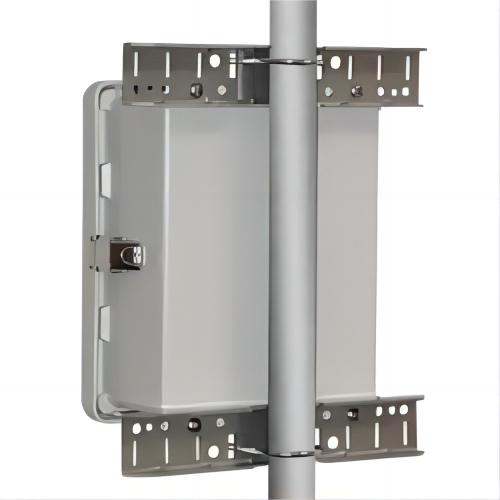
| Mounting | Wall or pole fixings, stainless screws, substrate condition, and whether the box orientation keeps the gasketed face out of driving rain |
| Drainage and condensation | Bottom-entry practice, drip loops, and vent or drain provisions for daily temperature cycling – covered in condensation and ventilation planning |
| Cable support | Glands with strain relief so cable weight never hangs on terminals |
| Entry sealing | Every used and unused opening closed with rated parts, torqued per instructions |
| Inspection | Interval for gasket condition, screw torque, UV crazing, and label legibility |
Standards and certifications
- IEC 60529. The IP code applied to outdoor boxes – IP65 minimum for sheltered outdoor use, IP66 for driving rain and hose exposure; the rating covers the tested configuration with its original gasket and entries.
- NEMA 250 / UL 50E. For North American projects, outdoor types (3R, 3, 4, 4X) apply to plastic constructions as well; UL 50E carries environmental construction requirements, and polymeric enclosures additionally rely on material-level evaluation such as UL 746C for outdoor UV exposure and flame ratings (UL 94 classes such as 5VA or V-0).
- IK code (IEC 62262). Impact resistance degrees for enclosures – the specification that separates vandal-prone sites from quiet backyards; verify the IK rating where impact is credible.
- RoHS and REACH. Declarations routinely required for polymer components exported to the EU.
- Temperature and UV evidence. Request the material datasheet’s operating range and the outdoor-aging qualification of the specific grade, and match it to the site’s extremes – plastic enclosure temperature behavior is treated in our temperature ratings guide.

Frequently asked questions
Are plastic junction boxes really suitable outdoors?
Yes, in the correct grade: UV-stabilized polycarbonate or GRP constructions serve decades outdoors. General-purpose ABS without stabilizers is the grade that fails. The specification should name the stabilized grade and request its UV evidence.
What IP rating does an outdoor box need?
IP65 for sheltered positions, IP66 where wind-driven rain or hose rinsing is expected. If flooding or burial is in scope, specify immersion-rated boxes and glands (IP67/IP68) rather than pushing a spray-rated box beyond its test.
Why not just buy stainless steel for every outdoor point?
Stainless wins where corrosion, heat, or impact extremes exist, but costs and weighs more, and coastal stainless still needs the right grade and hardware. For thousands of small signal points, stabilized plastic boxes with stainless fasteners are the economical engineering answer.
Do plastic boxes need earthing?
The box itself cannot be earthed, but the installation around it still can: metal glands, cable screens, and equipment bonding follow the installation rules. Where an earthed enclosure is part of the protective scheme, use metal – see the metal junction box use cases.
How long do the gaskets last?
It depends on the elastomer and the cycling: compression set over years of hot-cold cycles is the mechanism to manage. Ask for gasket material and compression-set data, stock spares, and put gasket inspection in the maintenance schedule.
Ordering scenarios
A telecommunications contractor rolling out 500 outdoor junction points across a Mediterranean market would specify UV-stabilized polycarbonate or GRP boxes, IP66 with gasket compression-set data, IK08-class impact where public access exists, stainless fasteners, and IK + IP + RoHS documentation in the tender package. A farm-irrigation project with 60 pump- and valve-side boxes takes the cost-sensitive branch – GRP boxes with IP65-class sealing, bottom cable entry with drip loops, drain provisions for condensation, and a documented inspection cycle – accepting plastic’s limits in exchange for corrosion immunity in fertilizer-rich air.
 EN
EN