







Most of the transformers on any power network are oil-immersed — and for durable reasons: oil is simultaneously the best available winding insulant and its own cooling medium, wrapped in a sealed steel tank that has proven itself across a century of service. The format spans pole-mounts, pad-mounts, and substation units from a few kVA to hundreds of MVA. This guide covers the oil-immersed transformer in its distribution-project dimensions: construction, fluid choices, preservation types, and the trade-offs against dry-type.
Construction anatomy
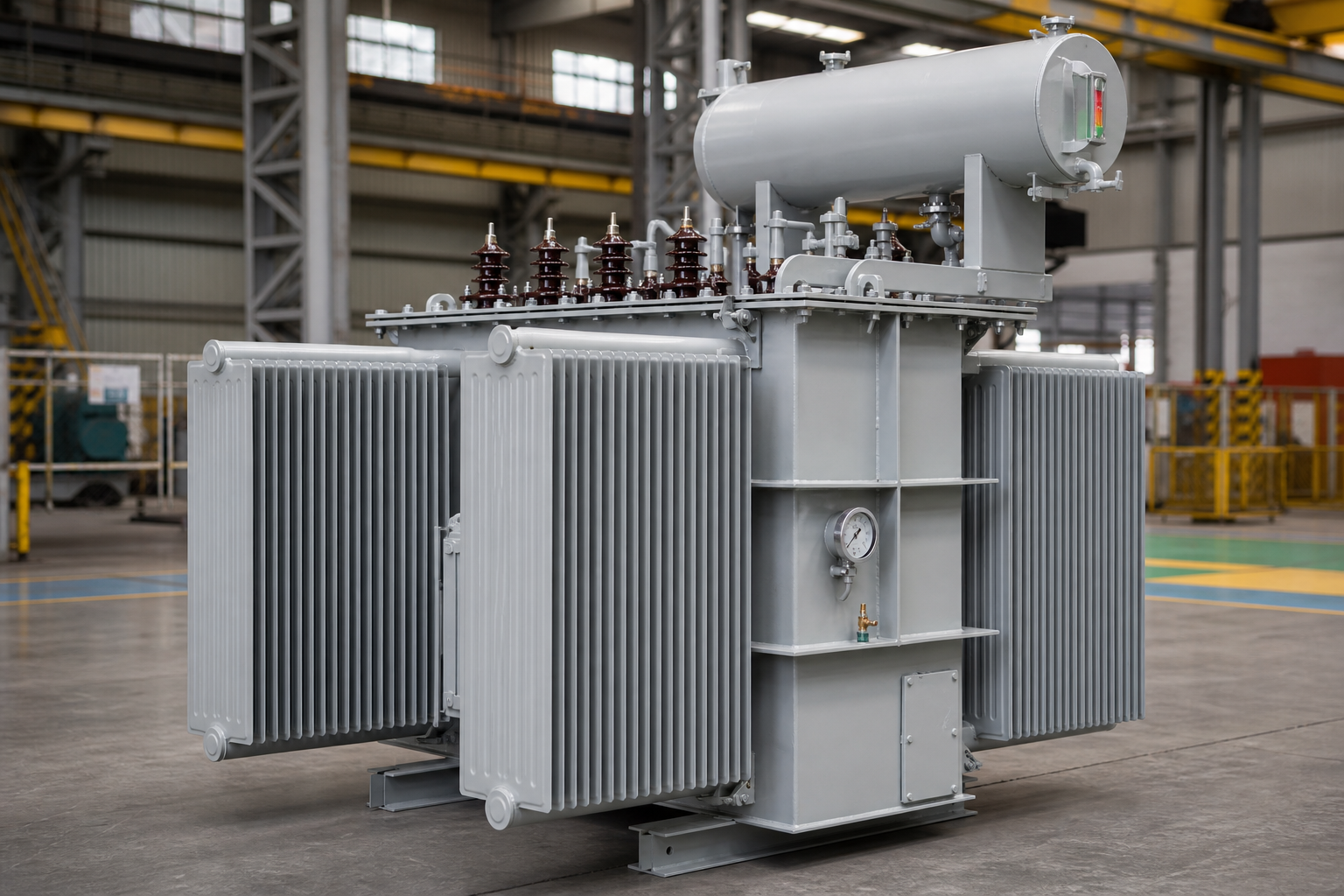
- Core and windings (CRGO or amorphous steel; copper or aluminum conductors) in a welded steel tank, submerged in insulation fluid.
- Cooling per the nameplate class — ONAN (natural convection through tank and radiators) as the distribution default, ONAF variants adding fans for a higher second rating (see our cooling class guide).
- Preservation system — how the oil stays healthy:
- Conservator (expansion tank) type: oil expands into a separate tank breathing through a dehydrating breather; supports Buchholz gas-actuated protection on larger units.
- Hermetically sealed type: the tank is sealed — the fluid and an air/nitrogen cushion absorb expansion; no breather, no moisture ingress path, minimal routine fluid attention. Common through mid distribution ratings.
- Protection package: off-circuit tap changer (typically ±2×2.5%), HV bushings with arrester coordination, and by rating: Buchholz relay, oil and winding temperature indicators, pressure relief device, and optional DGA monitoring.
- Terminations: cable boxes, bushings, or separable elbows (dead-front pad-mounts) matched to the network.
Fluid choice: mineral oil vs ester
| Mineral oil | Natural/synthetic ester | |
|---|---|---|
| Fire point | Reference (~160–170 °C class) | Higher (K-class fluids, fire point above 300 °C) |
| Environmental behavior | Standard containment obligations | Biodegradable — eases some siting constraints |
| Moisture behavior | Standard | Higher moisture affinity — different processing and sampling interpretation |
| Cost / availability | Economic default | Premium; verify manufacturer processing experience |
The fluid decision belongs to the specifying engineer balancing fire code relief, environmental exposure, and budget — and the transformer must be designed and tested with the actual fluid (fluid substitution in service is an engineering decision, not maintenance).
Where oil-immersed wins — and loses
Wins:
– Outdoor and utility duty economics — the cheapest reliable format per kVA in distribution service
– Harsh ambient tolerance in sealed constructions (no open insulation surfaces to pollute)
– Higher BIL options and proven overload behavior with conservative loading practice (per the applicable loading guide — IEC 60076-7 / IEEE C57.91)
Loses (to dry-type):
– Indoor installations near occupied space — fire code, containment, and vault requirements make dry-type the practical indoor standard
– Sites where a fluid leak of any kind is unacceptable
– Applications where transport mass or footprint rules oil out
The dividing line is almost always the building wall plus the fire authority — not a performance judgment.
Selection inputs
- Electrical: kVA, voltages and taps, vector group, impedance, insulation level pair (power-frequency + BIL — see our BIL guide), losses with tolerance, sound level where relevant.
- Format: pole-mounted / pad-mounted / substation; dead-front or live-front; loop or radial.
- Preservation: hermetically sealed vs conservator — a maintenance-philosophy decision (sealed minimizes routine fluid work; conservator enables Buchholz protection and easier oil handling on larger units).
- Fluid: mineral vs ester per fire/environment analysis.
- Compliance: IEC 60076 or IEEE C57 design basis; DOE 2016 / Ecodesign Tier 2 efficiency certification for the destination market; short-circuit withstand type-test evidence per IEC 60076-5 for the design family.
- Site: ambient and altitude derating, corrosion class of the tank finish, clearances, oil containment provisions per local environmental rules.
Altitude and volume interact in the preservation choice. For a 500-unit IEC-market program serving highland sites above the 2,000 m derating line, the sealed-versus-conservator decision stops being a per-unit preference: derating statements (cooling capacity and external insulation at the actual elevation) must appear on every datasheet in the fleet, and hermetically sealed construction carries a real maintenance argument at scale — no breathers to service across hundreds of unattended locations, no silica-gel logistics, and a moisture-ingress path that simply does not exist. Conservator units keep their place where the program’s larger ratings want Buchholz protection and easier oil handling, but for mid-distribution volumes spread across difficult geography, the sealed tank is the lower-lifetime-effort fleet decision.
Maintenance sketch (details in our maintenance planning guide)
Oil units trade lower first cost for a fluid-care regime: periodic sampling for dielectric strength and dissolved-gas analysis (DGA), gasket and paint attention, relay checks, and silica-gel breather maintenance where fitted. DGA trending is the single highest-value diagnostic in the industry — incipient faults announce themselves in gas signatures long before they become outages.
FAQ
Is “oil-filled” different from “oil-immersed”?
Terminology only — the same equipment family; North American practice favors “oil-filled,” IEC documentation favors “oil-immersed.”
What does hermetically sealed change for me?
It removes the breather and the moisture-ingress path: no silica gel to maintain, no conservator inspections — at the cost of Buchholz protection (which needs a conservator arrangement) on ratings where that matters. Through mid distribution ratings, sealed construction is the low-maintenance default.
How does the sealed-versus-conservator choice play at high altitude?
The preservation question is unchanged by elevation — sealed units keep their zero-moisture-ingress advantage — but derating does not wait: cooling and external insulation corrections apply above the 2,000 m line whichever tank you choose, and the datasheets for a highland fleet must state them per unit, not as a footnote.
For 500 units on an IEC program, which preservation type simplifies maintenance at scale?
Hermetically sealed, through the mid-distribution ratings: no breather replacement routes, no gel logistics, no conservator inspections across hundreds of sites. Reserve conservator construction for the larger units in the program where Buchholz protection and oil-handling access earn their maintenance calendar.
Do oil transformers pose a fire risk indoors?
Fire behavior is why indoor oil installations carry vault, containment, and suppression requirements in codes — which is exactly why dry-type (and cast-resin F1 for sensitive rooms) dominates indoor duty. Ester fluids relax some of the fire constraints; the code authority makes the final call.
When is amorphous core worth it in an oil unit?
Wherever no-load hours dominate: rural feeders, standby transformers, lightly loaded sites — the typical 60–70% no-load-loss reduction compounds over decades. Have both core materials quoted with guaranteed losses and run the payback (see our amorphous sourcing guide).
Related reading
- oil-immersed transformers — our liquid-filled product line.
- distribution transformers — the distribution formats that use these fluids.
- kVA calculator — rating selection before fluid and cooling decisions.
Engineering note: this article is a construction and selection overview from ElectricalCabinet.net, a manufacturer of oil-immersed and dry-type distribution transformers (pole-mounted, pad-mounted, substation formats) plus packaged substations and switchgear. Final fluid, fire-code, and installation decisions require qualified engineering review against applicable codes.
 EN