







At 1,000 kVA a transformer stops being catalogue shopping and becomes project engineering. The unit is a crane set measured in tonnes, its impedance materially shapes your fault study, its losses are a line item worth capitalizing, and its installation has civil, ventilation, and fire-code dimensions that a smaller unit never raises. This guide covers what buyers of a 1,000 kVA transformer need: the numbers, the construction options, the installation realities, and how to compare quotations.
The electrical picture at 1,000 kVA
Full-load line current, I = 1,000,000 ÷ (√3 × V):
| Voltage | Full-load current (3-phase) |
|---|---|
| 480 V | 1,203 A |
| 4160 V | 139 A |
| 12.47 kV | 46 A |
| 13.8 kV | 42 A |
At 480 V secondary, 1,000 kVA supports roughly 800 kW of continuous load at typical power factors — a serious building, a process line, or a mid-size data room. Impedance at this class commonly runs ~5.75–8% (design-dependent; the guaranteed value drives your LV fault level — a 1,000 kVA unit at 5.75% and one at 8% present very different secondary fault currents to the switchboard).
Construction options at 1,000 kVA
- Dry-type cast resin / VPI (indoor). The standard for in-building electrical rooms: MV primary (11/13.8/15 kV class) to 480/400 V secondary, Class F/H insulation, AN cooling with AF fan headroom commonly offered (fans buy overload capability, not continuous rating). Fire behavior class F1 per IEC 60076-11 where the room demands it.
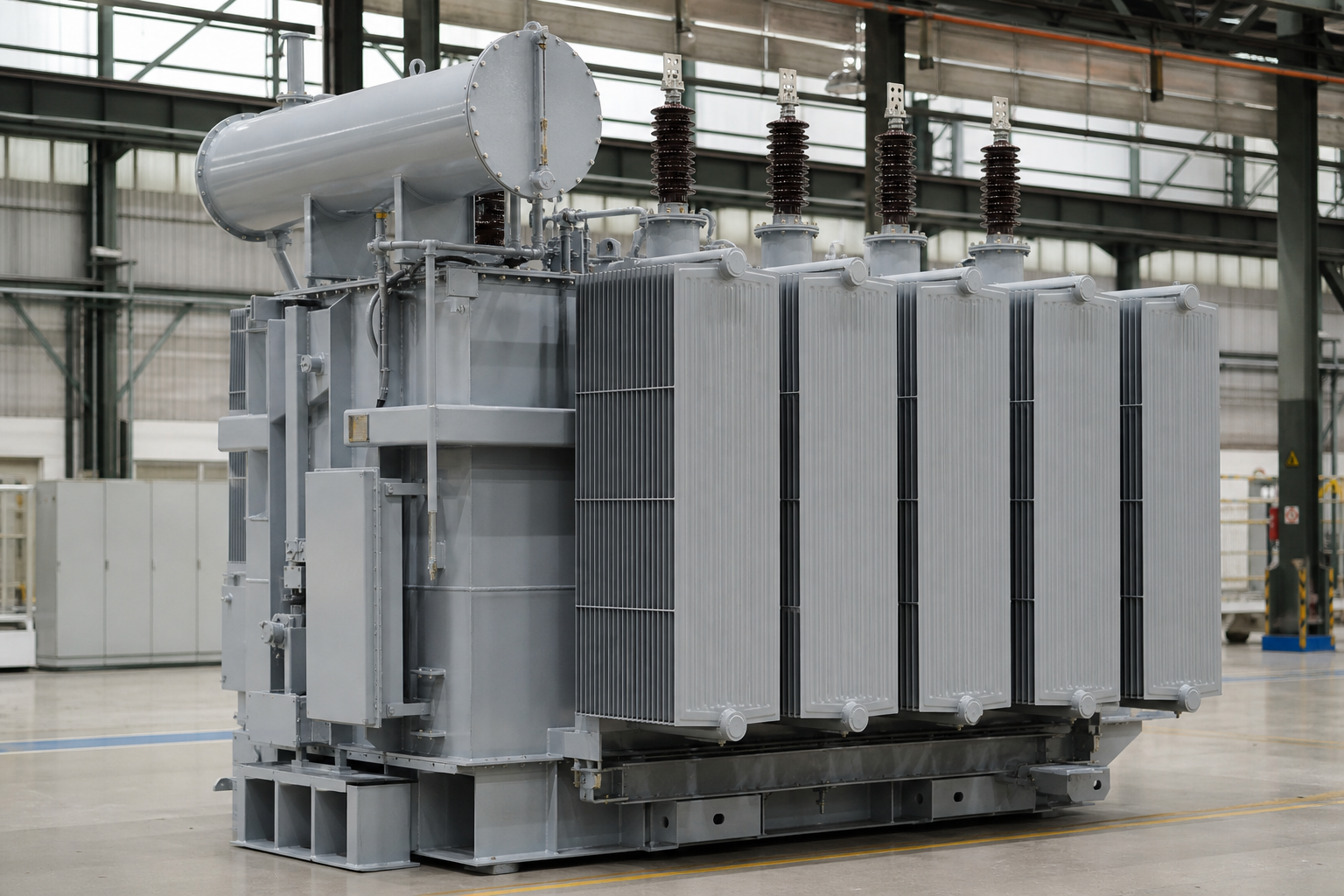
- Oil-immersed / pad-mounted (outdoor). Utility-style service: mineral oil or ester fluid, ONAN (fan-equipped ONAF variants for overload), dead-front or live-front terminations, tamper-resistant enclosure.
- Compact substation format. MV ring unit + 1,000 kVA transformer + LV board as one verified assembly (IEC 62271-202) — common where the site wants a walk-up solution rather than a built-up substation room.
Installation realities at this size
- Civil and lift engineering. Total masses run into the tonnes (fluid-filled units heaviest). The concrete pad or transformer room, rail or truck access, and lift method are decided by the GA drawing — request it at quotation stage, not after order placement.
- Ventilation (dry-type indoor). A 1,000 kVA unit at ~98.5–99% efficiency still rejects on the order of 10 kW of loss at full load into the room; the ventilation design must carry it (or the room derates the unit in return).
- Fault level at the LV bus. Impedance sets it; your LV switchgear breaking capacity and busbar bracing must coordinate. Lock the guaranteed impedance in the contract before switchgear is ordered.
- Terminations. MV cable boxes or elbows, and LV busduct or multi-cable compartments — assign interface responsibility (who supplies what) in writing between transformer and cable/switchgear suppliers.
- Fire and containment (oil units). Fluid type drives the fire and containment conversation: ester fluids bring higher fire point and biodegradability, easing some siting constraints. Local codes rule.
- Transport provisions. Larger units ship clamped, often with impact recorders; oil units ship filled or require site vacuum filling — a real cost and skill difference at commissioning.
Room conditions and rollout shape set the engineering priority. If the first release is 50 units for a multi-site program of back-planned electrical rooms that run hot — marginal ventilation against the roughly 10 kW each unit rejects at full load — then item 2 above is not a checklist line, it is the selection criterion: the room heat balance must be verified against the manufacturer’s ventilation requirements per site before the order is placed, because a 1,000 kVA unit installed into an under-ventilated room operates permanently derated and quietly shortens its insulation life. Back-planning works upstream too: room readiness and GA drawings must precede the production slot, or the transformer arrives to a room that cannot receive it — a crane appointment wasted and an energization date lost per site.
Cost factors: what separates two 1,000 kVA quotes
- Losses, capitalized. Guaranteed no-load and load loss with tolerance — the lifetime electricity value of loss differences at this size frequently exceeds the purchase-price spread between quotes. Compare on total owning cost.
- Core material. Amorphous-core options (typically 60–70% lower no-load loss) suit units idling long hours.
- Compliance documentation. DOE 2016 (US) / Ecodesign Tier 2 (EU) efficiency certification; IEC 60076 or IEEE C57 design basis; type-test references (short-circuit withstand per IEC 60076-5 within the design family).
- Construction and monitoring scope. Cast resin vs VPI; protection and monitoring package (temperature, Buchholz for oil units, DGA options) — the difference between a bare unit and an instrumented one.
- Test depth. Per-unit routine test report with measured values; partial discharge values for MV dry-type; sound level where contractual.
Selection checklist
- kVA, voltages, vector group, impedance, BIL, taps — locked identically across all quotes being compared
- Installation: indoor/outdoor, ambient, altitude, corrosion class, seismic where applicable
- Load profile: harmonics (k-rated need), motor starting, growth margin
- Standards regime and efficiency documentation for the destination market
- GA drawing with masses at quotation; FAT attendance or third-party inspection for a unit this size
FAQ
How much does a 1,000 kVA transformer cost?
Construction (dry vs oil vs substation package), loss level, core material, and monitoring scope drive wide spreads, so a single number misleads — lock the electricals identically across quotes and compare on total owning cost. The cost factors above tell you where differences legitimately sit.
Which factors remain open to optimization after the electricals are locked?
Monitoring scope and enclosure/finish options, plus the commissioning scope boundaries (site filling versus factory-filled oil units). Loss level and core material stay lifetime decisions — at 1,000 kVA the capitalized loss stream across service life usually outranks every negotiable line on the quote.
For a first release of 50 units into back-planned electrical rooms, what does room heat do to the priority order?
It moves ventilation verification to the front. Each unit rejects on the order of 10 kW at full load; a marginal room derates the fleet permanently. Verify each room’s heat balance against the manufacturer’s clearance and ventilation data at design review — before the slots are booked — and sequence GA-drawing release ahead of production so civil readiness never chases the delivery.
Dry-type or oil for a 1,000 kVA installation?
Indoor, near occupied space, fire-sensitive: dry-type (cast resin where F1 applies). Outdoor, utility-style, budget-driven: oil/ester. The building wall and fire code make the call, not preference.
Can I parallel two 1,000 kVA units instead of buying one 2,000 kVA?
Yes — with matched impedance, ratio, vector group and a paralleling study (see our parallel operation guide). Two smaller units buy redundancy and better part-load efficiency at higher complexity and usually higher total cost.
What maintenance does a 1,000 kVA unit need?
Dry-type: ventilation cleaning, connection checks, fan verification, optional PD trending. Oil units: oil sampling and DGA trending, relay checks, gasket and paint attention — see our maintenance planning guide for the schedule logic.
Related reading
- 1000 kVA transformer calculator — verify the full-load currents used in this guide.
- distribution transformers — the product family a 1000 kVA unit belongs to.
- dry-type transformers — the indoor alternative at this rating.
Engineering note: this article is a rating-specific selection reference from ElectricalCabinet.net, a manufacturer of distribution transformers (dry-type cast resin/VPI, oil-immersed, pad and substation formats) and LV/MV switchgear. Current values are planning figures; final installation, protection, and civil design require qualified engineering review against applicable codes.
 EN