







低压开关柜 是电气系统的重要组成部分,既能提供安全,又能进行控制。了解基本原理对于任何从事电气工程或维护工作的人员都至关重要。
本指南旨在向新手介绍低压开关设备的基本概念、组件、功能和应用,为进一步学习奠定基础。
什么是低压开关设备?
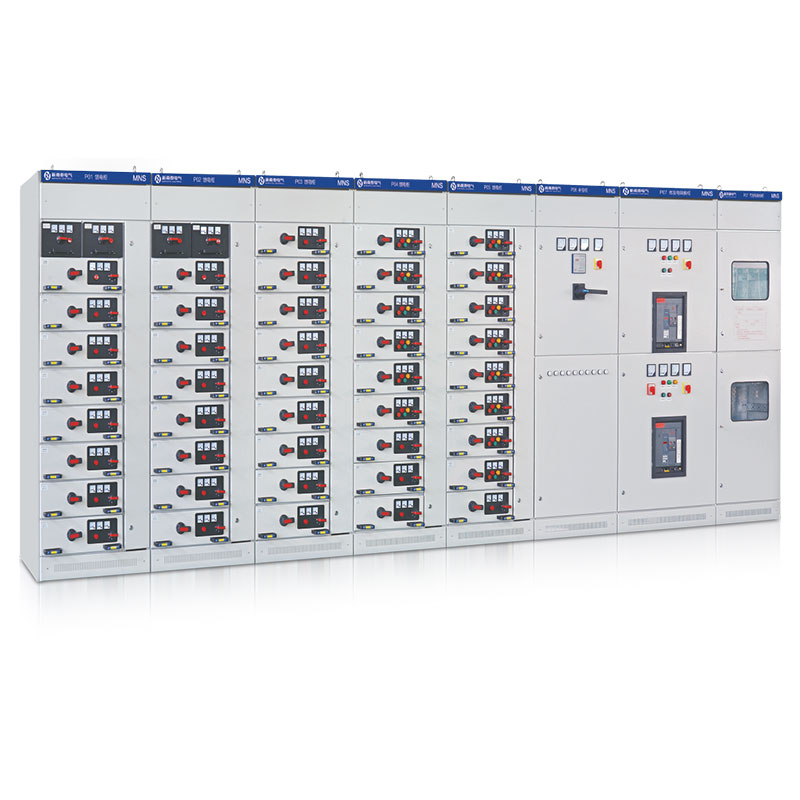
低压开关柜(LV)是一种三相配电装置,可提供高达 1,000 伏特的电力和高达 6,000 安培的电流。这些设备通常用于室内,封闭在一个金属箱内,箱内装有铜导线以及断路器和隔离器组合。
电气 开关设备类型
开关设备系统分为三个不同等级:低压、中压和高压。
- 高压开关柜: 高压开关柜(HV)是指控制 75KV 或更高电压的开关柜。由于这些断路器是专为高压使用而设计的,因此通常具有更高的安全性能。
- 中压开关设备: 中压开关设备用于 1 KV 至 75 KV 的系统中。这种开关设备通常用于包括电机、馈电电路、发电机以及输配电线路在内的系统中。
- 低压开关柜: 低压开关设备(LV)设计用于调节 1KV 以下的系统。它们通常安装在配电变压器的低压侧,广泛应用于各行各业。
低压开关设备的主要组件
低压开关、漏电断路器、HRC 熔断器、电气隔离器、空气断路器 (ACB)、塑壳断路器 (MCCB) 和微小断路器 (MCB) 都是额定电压为 1KV 的低压开关设备。

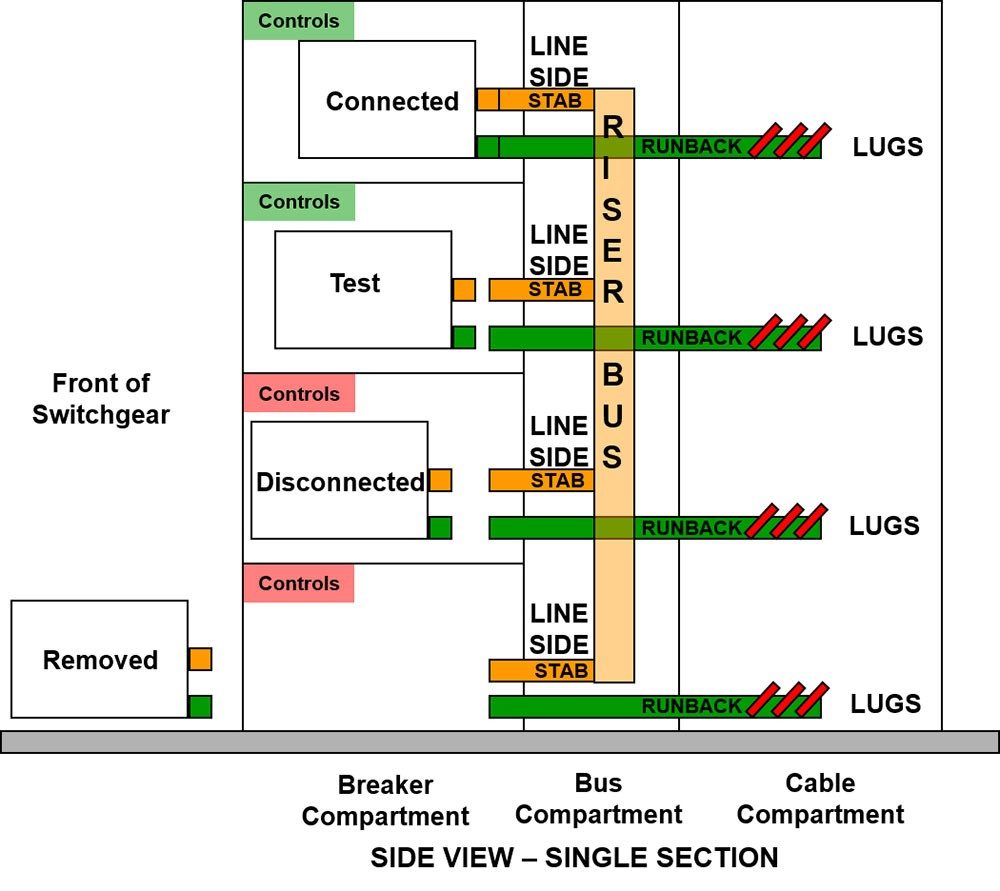
- 断路器舱: 在过载或短路情况下自动切断电流的装置。类型包括微型断路器 (MCB) 和塑壳断路器 (MCCB)。
- 开关: 用于打开和关闭电路的机械装置。它们可以手动或自动操作。
- 巴士车厢 母线室位于断路器室的后面,同样由坚固的屏障隔开。
- HRC 引线: 当电流超过一定阈值时,安全装置会熔化并断开电路。保险丝类型包括盒式保险丝和插头式保险丝。
- 机箱:保护壳:开关设备部件的保护壳,确保安全并符合以下标准 IP 等级 防尘防水。
- 电缆舱 电缆室位于开关柜部分的后面,可以使用通风或非通风隔板将其与母线室隔开。
- 以及保护系统所需的其他配件
低压配电柜区域的基本功能
| 电气保护 | 隔离 | 控制 |
|---|---|---|
| 过载电流 | 经授权的防故障机械指示器清楚显示隔离情况 | 功能切换 |
| 短路电流 | 由经授权的防故障机械指示器显示隔离情况 | 应急开关 |
| 绝缘故障 | 紧急停车 | |
| 在断开的触点之间有明显的间隙或中间绝缘屏障 | 在打开的触点之间明显可见间隙或中间的绝缘屏障 |
低压开关设备的应用
- 发电站
- 变电站
- 汽车行业
- 基础设施
- 机器构造
- 化学品和石化产品
- 制药业
- 石油和天然气工业
- 纸浆和造纸业
- 水泥行业
- 采矿业和钢铁厂
- 废物处理
- 水资源管理
- 钢铁和金属工业
- 玻璃行业
- 工厂建设
- 数据中心
- 以及更多
低压开关柜的优点
- 确保安全无恙低压开关设备的最大优点之一是,它能阻止电气问题和事故的发生,从而提高安全性。
- 速度和可靠性 它确保电力系统运行良好,从而减少停机时间并提高效率。
- 有效利用资金: 从长远来看,低压开关设备可以节省资金,因为它可以防止设备损坏并降低维护成本。
低压开关常见问题
开关设备和配电盘有什么区别?
由于开关设备和配电板的配置方式几乎是无穷无尽的,每一种都具有另一种所不具备的功能,因此无法直接比较大小和功能完全相同的系统的成本。尽管如此,工程师还是可以推断出,即使考虑到附加功能和控制线的费用,根据分隔式开关柜所需的较大尺寸和材料数量,配电盘通常是一种成本低得多的替代方案。
阅读更多配电盘与开关设备
低压开关设备是否易于使用?
作为开关设备制造商,我们根据建筑物或应用的规格定制开关设备,通常安装在工厂或配电室等 "受控环境 "中。
有些系统操作简单,而有些系统则相当复杂。我们通常建议人们在操作任何低压开关设备之前接受培训,因为如果操作不当,犯错可能会付出高昂代价或造成灾难性后果。我们敦促只有经过培训和认证的合格人员才能操作带电开关设备,并且为了自身安全,在开关设备时必须佩戴个人防护设备 (PPE)。
Updated Selection Guidance
This section is a supplemental review draft. Consolidate overlapping passages before replacing the production URL.
Low-voltage switchgear is an assembly used to switch, protect, distribute, and sometimes monitor electrical power on the low-voltage side of a system. The exact arrangement depends on the incoming supply, feeders, loads, protection strategy, access requirements, and applicable project requirements.
This guide is intended to strengthen the existing low-voltage switchgear article. It explains selection inputs without claiming a universal voltage range, short-circuit rating, certification, or installation method for every product.
What low-voltage switchgear does
A low-voltage switchgear assembly can provide a controlled point for incoming power, feeder distribution, isolation, protection, metering, and operational control. The equipment may be arranged as a lineup or another documented assembly, depending on the system and product scope.
Switchgear should not be confused with every type of panelboard, switchboard, or control panel. Those terms can overlap in casual discussion, but the equipment function, construction, protection devices, and project standard must be checked in the technical specification.
Common functional sections
The following sections are commonly considered when defining a low-voltage switchgear lineup:
– incoming or main switching section; – bus or distribution section; – outgoing feeder sections; – circuit breakers, fuses, or other protective devices; – metering and monitoring interfaces; – control power and auxiliary circuits; and – cable termination and access provisions.
The actual lineup may contain only some of these sections. A product brochure or generic diagram should not be treated as the final project arrangement.
Inputs to define before selection
System and load information
Provide the supply information, load schedule, feeder count, motor or transformer connections, and expected operating conditions. Protection and equipment selection depend on these inputs, not only on a nominal system label.
Feeder and bus arrangement
Describe the number and type of feeders, required separation, bus arrangement, cable entry, and any planned future sections. If the project needs transfer, tie, metering, or sectionalizing functions, state them explicitly.
Protection and monitoring
Identify which devices need overcurrent protection, isolation, metering, status feedback, or remote communication. Protection coordination, fault duties, and settings require project-specific engineering information and should not be invented in a content article.
Installation environment
Record the installation location, ambient conditions, access direction, mounting, cable routing, maintenance approach, and enclosure requirements. Confirm any NEMA, IP, UL, IEC, or other compliance statement from the exact product documentation.
Types and terminology
Low-voltage switchgear may be described by construction, access, feeder arrangement, or protective device. Terms such as fixed, withdrawable, metal-enclosed, service entrance, or distribution lineup describe different aspects of the assembly and should not be treated as interchangeable labels.
The existing A Beginner’s Guide to Low-Voltage Switchgear can serve as the category overview. The Electrical Switchboard vs. Switchgear article covers a related terminology comparison. Link to the relevant product page only after confirming that the actual product scope matches the requirement.
Documentation for a quotation or design review
A useful inquiry package may include:
| Input or document | Why it matters |
|---|---|
| Single-line diagram supplied by the project team | Defines the intended system relationships |
| Load and feeder schedule | Establishes connected equipment and feeder count |
| Site and installation information | Affects access, cable entry, and enclosure decisions |
| Protection and metering requirements | Identifies required devices and interfaces |
| Required drawings and data sheets | Sets the expected documentation package |
| Future expansion assumptions | Prevents unrecorded lineup or space assumptions |
The supplier should identify assumptions, exclusions, and the exact configuration offered. That is more reliable than selecting a lineup from a generic type name.
Selection checklist
Before approving a low-voltage switchgear proposal, verify:
- incoming supply and feeder information;
- load and motor data;
- bus and section arrangement;
- protection and metering scope;
- cable entry and access requirements;
- installation environment and enclosure documentation;
- drawings, manuals, and inspection deliverables; and
- assumptions about future expansion or site work.
The final choice should be tied to the approved project documents and the exact product configuration. A general guide can organize the decision, but it cannot approve protection settings or certify an installation.
Browse this topic: Switchgears technical hub
 ZH
ZH  EN
EN  EN_ZA
EN_ZA  AR
AR  EN_GB
EN_GB  DE
DE  ES
ES  FR
FR  IT
IT  JA
JA  TR
TR  RU
RU  EN_CA
EN_CA  EN_AU
EN_AU  NL
NL  PT
PT  FA
FA